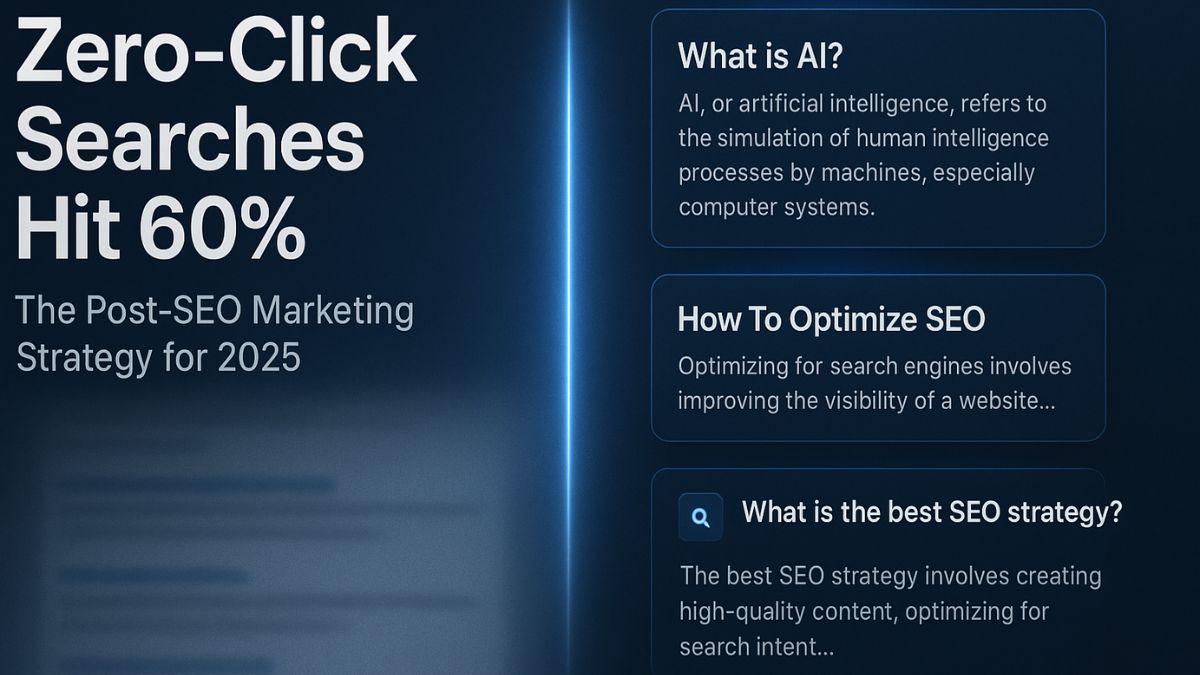
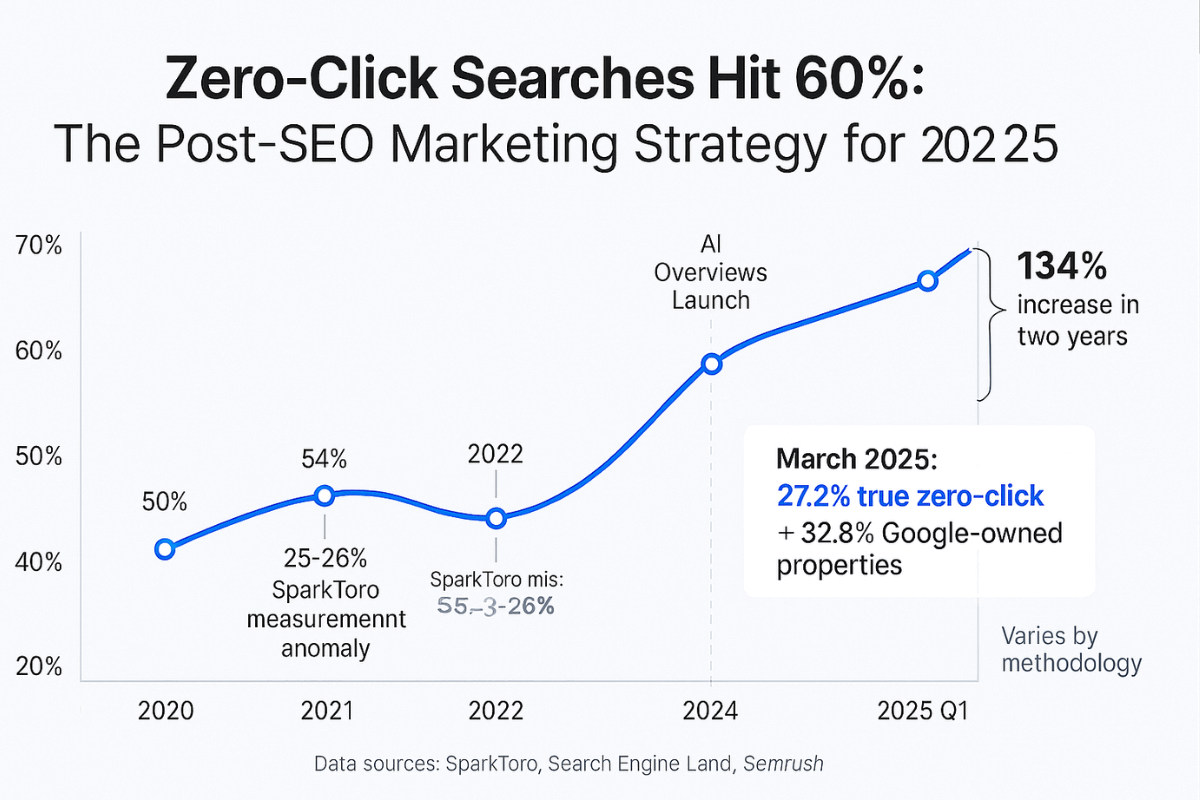
Here's the paradox every CMO is feeling right now. Google searches are up across almost every category. But only 40% of US searchers click organic results—down from 44% last year. Zero-click searches climbed from around 25% in early 2024 to approximately 60% by late 2024. With AI Overviews now showing up in over half of queries, the rules didn't change—they were rewritten.
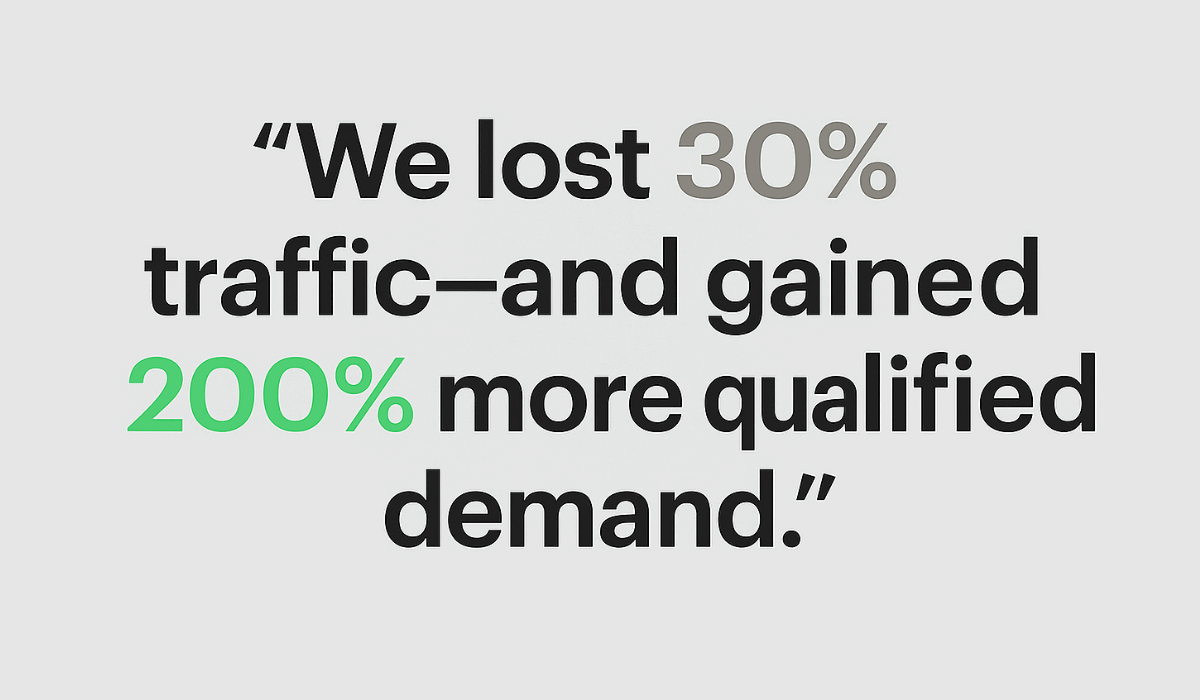
This isn't the end of SEO. It's the evolution of how visibility turns into demand. Brands that adapt are thriving. We've seen companies triple qualified leads even while traffic drops 30%. In this playbook, you'll learn why the "SEO is dead" take is wrong, how the AI Citation Economy rewards brand authority, and the exact 90-day roadmap agencies are using to increase leads while traffic falls.
The AI Citation Economy: How Value Exchange Is Shifting
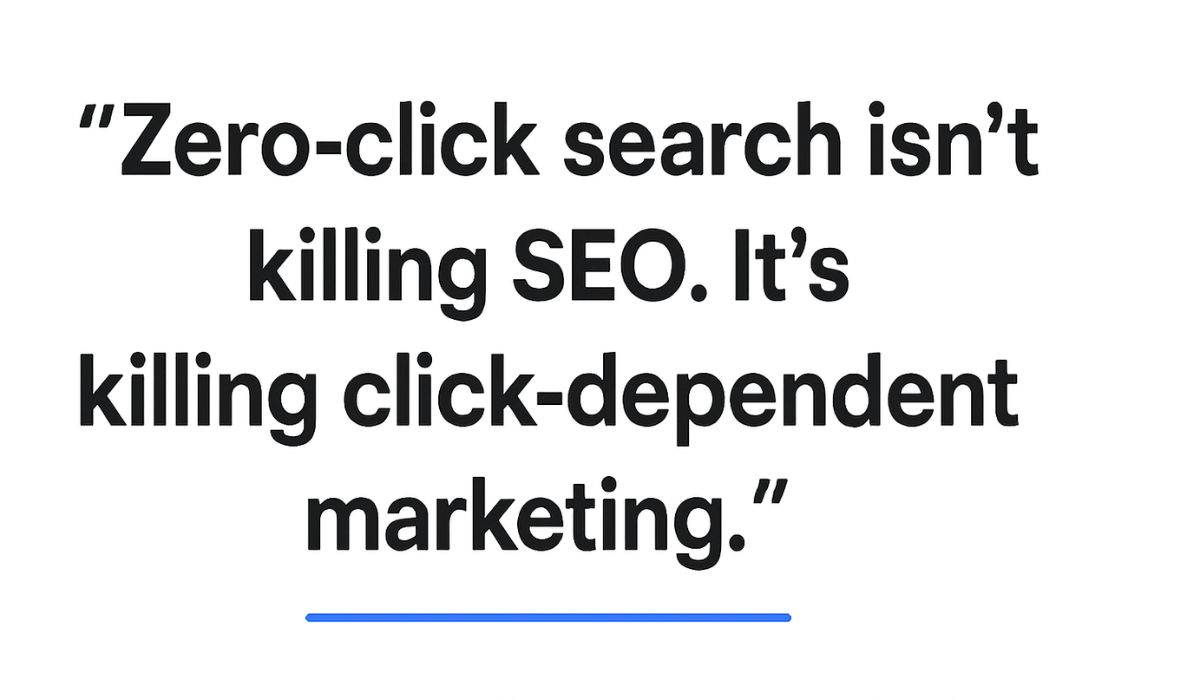
Zero-click doesn't mean zero value. It means the value moved.
When your brand is cited in an AI Overview, everything changes. Research from Seer Interactive analyzing over three million impressions shows cited brands see 35 percent more organic clicks and 91 percent more paid clicks than those left out. That visibility signals trust long before the click, lifting conversion rates when people do search your brand later.
The pattern is clear. For informational queries with AI Overviews, brands not cited can see organic click-through rates drop by as much as 65 percent year-over-year. But brands that win citations maintain a traffic advantage while competitors decline—and that traffic converts better because the citation acts like a credibility stamp.
Look at Reddit. The platform has emerged as a dominant source for AI citations across multiple platforms. Analysis from Profound examining over 30 million citations shows Reddit accounting for 21 percent of Google AI Overview citations and an even higher 46.7 percent of Perplexity citations. User-generated content now accounts for substantial share of AI citations, with Reddit becoming one of the most-cited domains across AI search platforms.
Here's the mindset shift. Company A ranks number one and converts 2 percent of anonymous traffic. Company B gets cited in AI answers, becomes familiar, and converts 14 percent via branded search. Same effort. A very different pipeline.
Measurement must evolve with it. Impressions and traffic used to tell the story. Now you need to track citation frequency, brand mention share of voice, and entity coverage in AI-assisted results. Recent algorithm updates increasingly reward brands with strong health signals and offsite authority—multiple click sources beyond organic search bolster legitimacy.
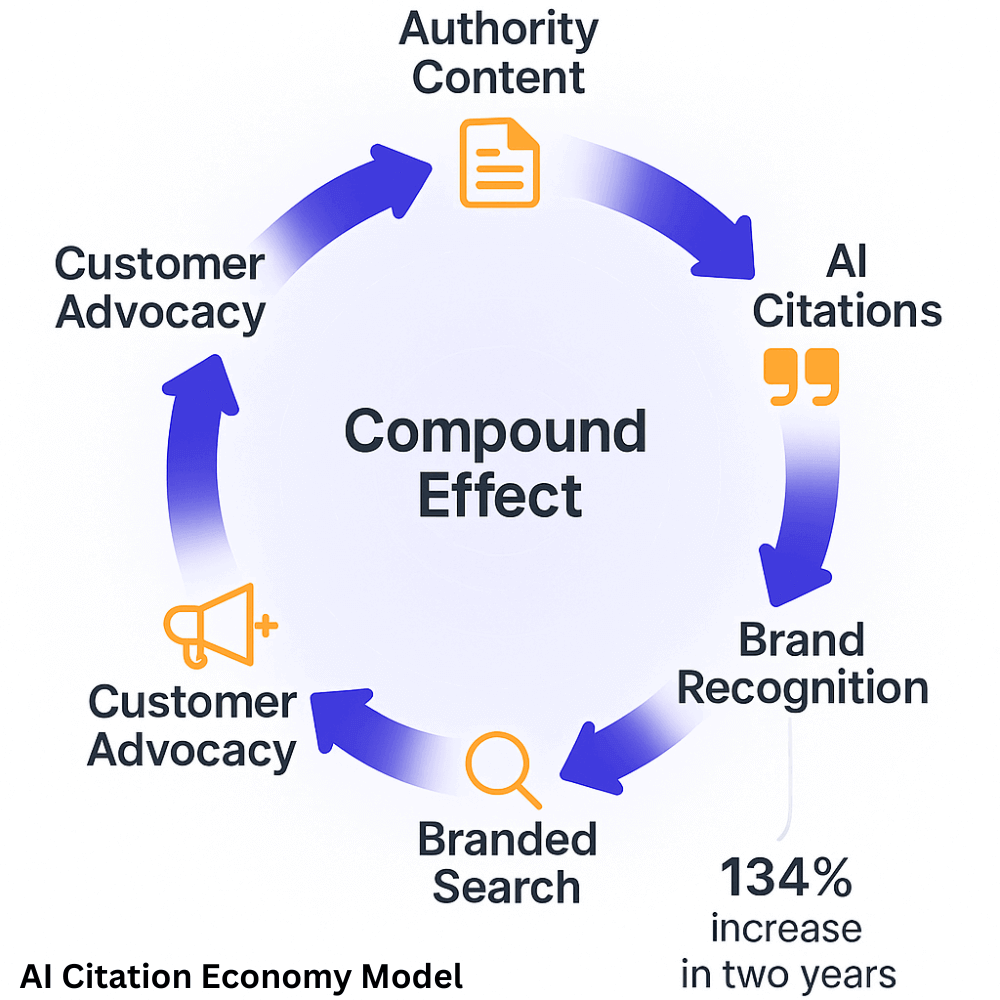
Authority Content → AI Citations → Brand Recognition → Branded Search → Direct Traffic → Customer Advocacy → reinforces Authority
This isn't a theory. B2B companies securing AI Overview citations report meaningful increases in brand searches within months—without changes in traditional rankings.
Brand SEO vs. Traffic SEO: The Strategic Pivot
The old playbook optimized for clicks. The new one optimizes for recognition.
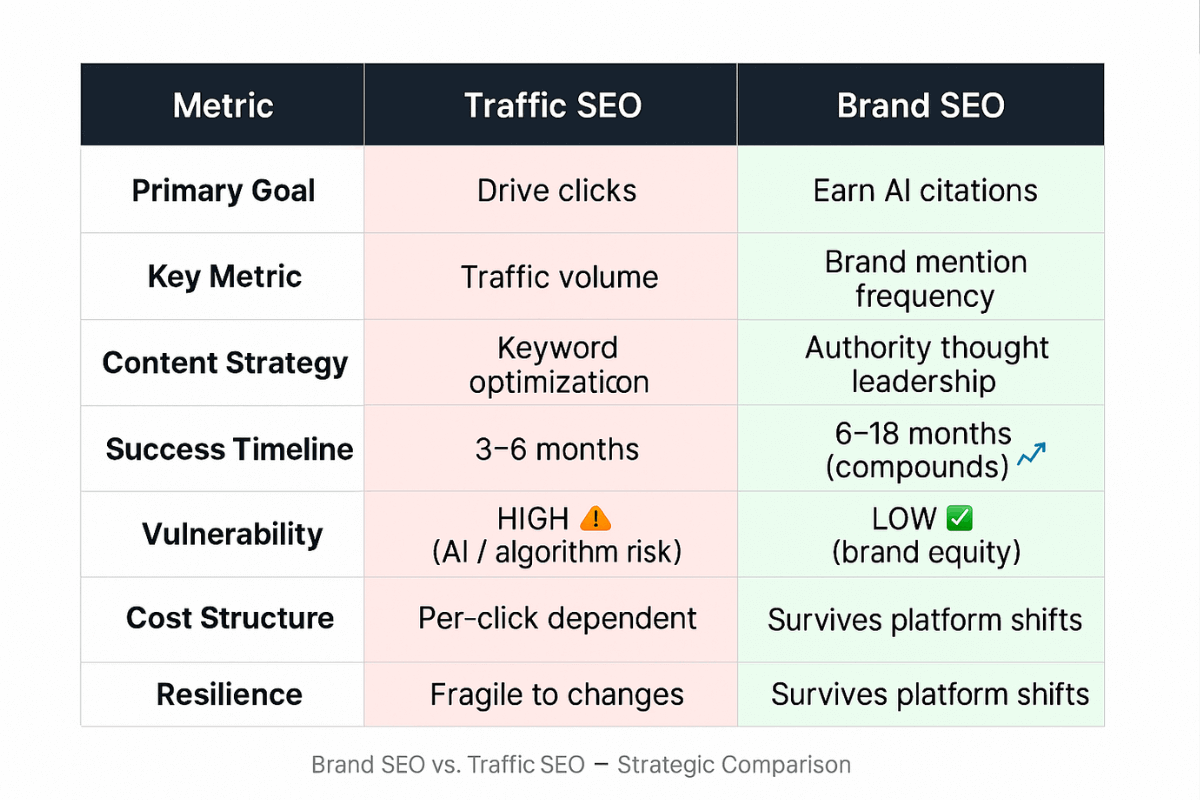
Traffic SEO:
- Goal: Volume
- Metric: Visits
- Content: Keyword-optimized articles
- Timeline: 3–6 months
- Risk: High. AI Overviews and answer engines intercept clicks
Brand SEO:
- Goal: Recognition and authority
- Metric: Mentions and citation share
- Content: Thought leadership AI tools want to reference
- Timeline: 6–18 months of compounding equity
- Risk: Low. Brand strength survives platform shifts
The business case is real. Approximately one in three searches is branded—people already know who they want. Brand equity compounds while traffic SEO plateaus against AI interference. Marks and Spencer proved it: the UK retailer tripled visibility since 2020, cut paid search spend by 64 percent, and now ranks first for competitive terms like "curtains" and "linen trousers" by prioritizing authority over traffic.
Run a quick check. What's your brand search volume vs. category search volume? Below 15 percent? You're too dependent on algorithms you don't control. Above 30 percent? You've built resilient equity that will outlast zero-click dominance.
Analysis across tens of thousands of sites points to the same conclusion: brands with strong offsite authority are seeing organic resilience—even as AI Overviews proliferate. The differentiator isn't a clever SEO trick. It's a brand strength.
Every quarter you keep optimizing for yesterday's rules, a competitor strengthens tomorrow's advantage.
Diversifying Beyond Google Organic: The Multi-Channel Imperative
Over-relying on Google organic isn't just risky—it's indefensible.
LinkedIn dominates B2B discovery. The majority of B2B marketers use it as a primary distribution channel. Video increases dwell time, and native newsletters notify subscribers directly. More important: LinkedIn thought leadership helps AI systems recognize your entity, which boosts citation potential.
Email is your highest-leverage owned channel. It's direct relationship equity. No algorithm. No zero-click. For nurturing and conversion, email consistently wins—and you control the audience.
Reddit and communities deliver an AI citation premium. With Reddit representing 21 percent of Google AI Overview citations and over 40 percent of citations across all AI models according to some analyses, authentic, practitioner-led content from communities is now a core source for AI. Professional services firms are turning community leadership into consultation requests worth significant revenue—without traditional ads.
YouTube and podcasts solve the multimodal gap. YouTube's transcripts feed AI extraction while video builds recognition. Voice-search optimization overlaps with YouTube SEO—the same conversational, answer-first structure serves both.
Apply the 70-20-10 mix:
- 70% owned (email, LinkedIn, community)
- 20% earned (citations, PR, guest contributions)
- 10% Google organic
You're not abandoning SEO—you're right-sizing dependence on platforms you don't own.
Ask yourself: What share of your leads comes from channels you control vs. channels you rent? If Google organic supplies over 40 percent of acquisition, you're carrying concentrated platform risk—precisely where AI adoption bites hardest.
Meanwhile, AI-native discovery is growing. Referral traffic from AI platforms is rising. The question isn't if you'll diversify, but whether you'll do it proactively or under pressure.
Case Study: Tripling Qualified Leads with 30% Less Traffic
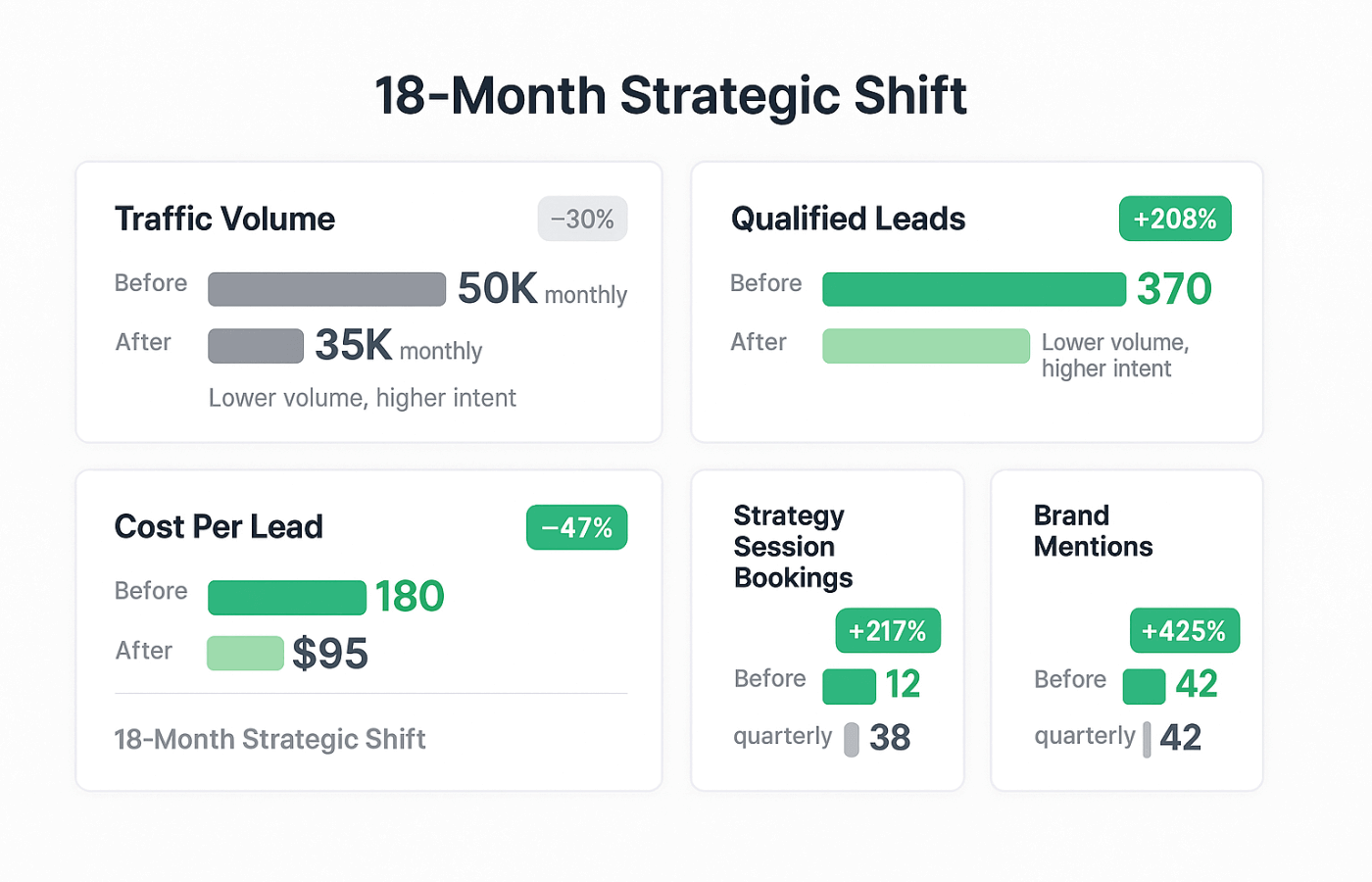
A healthcare marketing agency at $8M in revenue faced what many teams see now: traffic dropped from 50K to 35K monthly over 18 months (minus 30 percent), organic CTR fell 34 percent, and leadership questioned ROI.
They didn't double down on keywords. They pivoted to Brand SEO and multi-channel.
Months 1–6 (Foundation)
- AI citation audit showed they appeared in just 6 percent of target queries; competitors averaged 12 percent
- Brand mentions: 8 per quarter vs. 18 for competitors
- Launched a LinkedIn newsletter focused on healthcare marketing insights. Baselines set.
Months 7–12 (Pivot)
- Shifted from generic "SEO content" to contrarian thought leadership
- Joined five healthcare marketing communities on Reddit and contributed real expertise
- Implemented schema for FAQs and How-Tos to make answers extractable by AI
- Built email lists with gated research reports
Months 13–18 (Scale)
- AI Overview appearances: 6% → 23% of target queries
- Brand search volume: +87%
- LinkedIn newsletter: 2,400 subscribers, 34% open rate
- Earned 12 community-linked AI citations
Results:
- Traffic: 50K → 35K (-30%)
- Qualified leads: 120 → 370 (+208%)
- Cost per lead: $180 → $95 (-47%)
- Strategy session bookings: 12 → 38 (+217%)
- Brand mentions: 8 → 42 per quarter (+425%)
- Customer LTV: +62%
As their CMO put it, "We stopped chasing traffic and started building authority. AI citations drove brand recognition, which drove branded search, which drove higher-intent leads. The compound effect was exponential."
Your 90-Day Post-SEO Marketing Roadmap
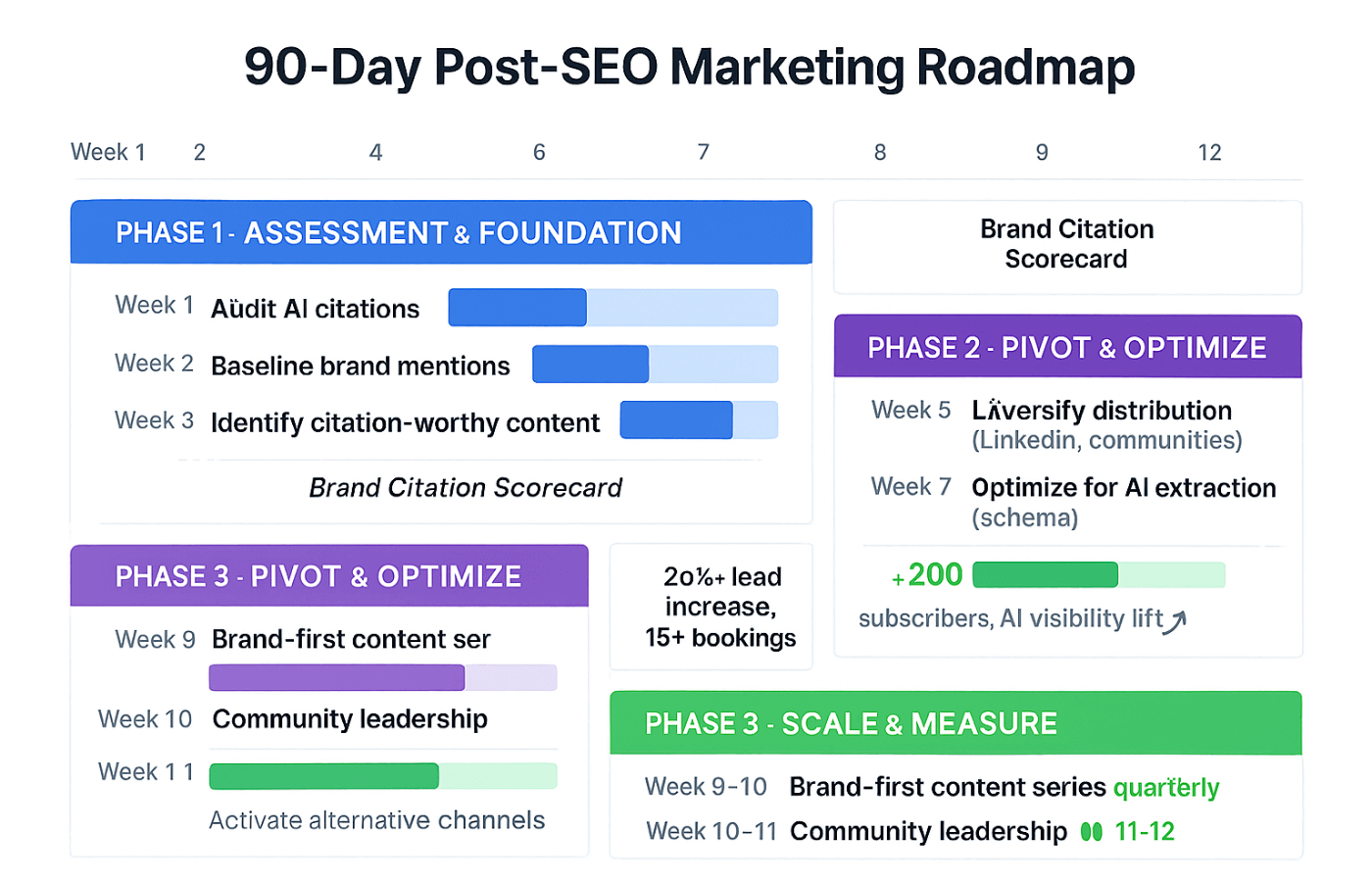
Days 1–30: Assessment & Foundation
Audit AI citations: Use available tools to see where your brand appears in AI Overviews. Document which queries trigger summaries, whether you're cited, and who is.
Baseline brand mentions: Track current share of voice and compare to key competitors.
Identify citation-worthy content: Flag assets that demonstrate expertise, experience, authoritativeness, and trust. Map the questions your audience asks AI tools.
Run a multi-channel audit: LinkedIn engagement vs. industry benchmark, email list size and open rates, and presence in communities and industry forums.
Deliverable: A brand citation scorecard with baselines.
Days 31–60: Pivot & Optimize
Diversify distribution: Launch a LinkedIn newsletter, join 3–5 relevant communities, and secure 2–3 guest contributions on authoritative sites to build offsite signals.
Optimize for AI extraction: Implement schema (FAQ, How-To, product, reviews) and structure content for answer-first clarity. Target featured snippet formats.
Publish thought leadership with a point of view: Contrarian, data-backed perspectives, expert roundups, and original research that earn citations.
Build your email list: Gated whitepapers, templates, calculators, and webinars; use native lead gen to capture demand.
Deliverable: 200+ newsletter subscribers; meaningful lift in AI Overview appearances.
Days 61–90: Scale & Measure
Run a brand-first content series: Weekly thought leadership with video or podcast versions. Repurpose rigorously.
Establish community leadership: Answer questions, share evidence, and earn citations from industry publications. Prioritize authenticity in communities.
Activate alternative channels: Book 3–5 podcast guest spots, co-host a webinar series, and publish YouTube content with transcripts optimized for AI extraction.
Build a new KPI dashboard: Track brand search trends, assisted conversions, AI citation share by query category, LinkedIn engagement, and email list growth and conversion.
Deliverable: 20%+ increase in qualified leads; 15+ strategy session bookings tied to new channels.