Between 2017 and 2024, sales headcount at product-led growth companies grew 45% year-over-year—faster than any other function. Today, salespeople represent 30% of employees at Slack and Dropbox, and 45% at Zoom and Datadog.
That shift isn't a rumor—it's a signal. The companies that popularized "the product sells itself" are hiring salespeople faster than anyone else.
Why are the pioneers of the "self-serve forever" philosophy now investing so aggressively in sales? The answer isn't failure—it's mathematics. With only 9% of free users converting to paid on average and median annual contract values topping out at $25,000, pure product-led growth (PLG) hits a predictable ceiling. The sharpest operators spotted this constraint early and adapted ahead of the pack.
You're about to discover:
- Why the math of pure PLG has limits
- The three symptoms that signal it's time to evolve
- The exact playbook for building a hybrid growth motion without breaking what already works
- How to diagnose your situation, avoid cultural friction, and implement a 90-day plan that translates product momentum into enterprise-scale revenue
The PLG Paradox: When Success Becomes the Ceiling
Product-led growth succeeded brilliantly at what it was designed to do: create viral adoption, deliver immediate value, and keep customer acquisition costs low. That's the foundation every modern SaaS leader wants.
But as PLG companies scale, mathematical limits emerge that no amount of in-product optimization can fully overcome.
The Uncomfortable Arithmetic
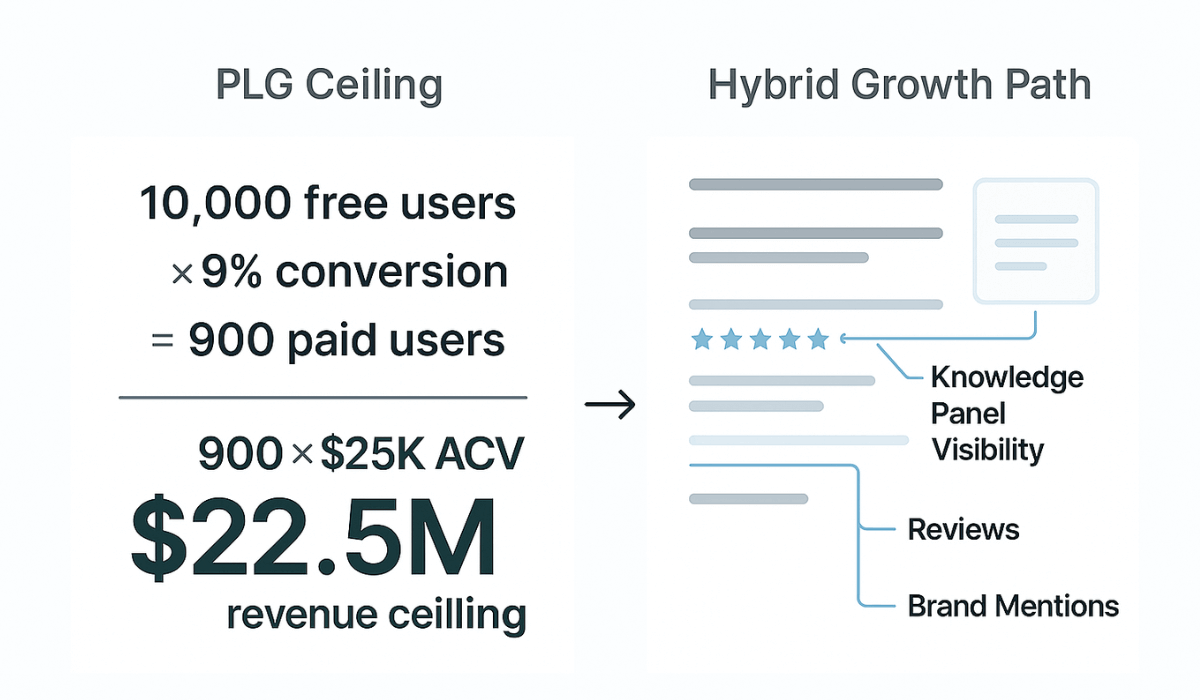
You have 10,000 free users—impressive at first glance. Multiply that by the 9% industry-average conversion rate and you end up with 900 paid customers. At a $25,000 median ACV, you've built a $22.5 million business.
To reach $50 million through pure self-serve, you'd need:
- 22,222 free users converting at the same rate
- CAC, support, and infrastructure costs scaling linearly
- No degradation in conversion as you scale
That's the freemium revenue ceiling in action.
Can you turn $500-per-year user subscriptions into $500,000-per-year enterprise contracts without sales? Procurement departments, security questionnaires, executive buy-in requirements, and multi-stakeholder decision processes say no. The enterprise motion isn't just bigger deal sizes—it's a different buying behavior that demands human intervention.
The Market Reinforces This Reality
Growth-focused companies command 10.7x revenue multiples when growing 25% or more annually, and capital is flowing primarily to proven scalers rather than early experiments. The pressure for efficient growth is intense.
As Jason Lemkin of SaaStr notes: "Getting 15–20% of customers from self-service often makes the difference between cash-flow positive and not—but the remaining 80–85% typically requires a different motion entirely."
This isn't about PLG failing its promise. Product-led growth created the foundation—viral adoption mechanisms, low-friction onboarding, and product-qualified leads (PQLs). What it can't do alone is navigate Fortune 500 procurement cycles or close six-figure deals that require custom contracts, specialized validation, and legal finesse.
Three Symptoms Your PLG Model Hit Its Limit
Symptom #1: The Conversion Plateau
Your monthly free-to-paid conversion has stalled at 8–12% for three consecutive months despite product improvements, feature releases, and onboarding optimizations. You're brushing up against the industry ceiling where self-serve tends to max out.
Users love the product—your NPS scores prove it—but they cite "need to talk to my team" or "budget approval required" before upgrading. The product has done its job qualifying interest; it cannot, on its own, navigate organizational buying.
Sound familiar?
Symptom #2: The ACV Ceiling
Your average contract value hovers stubbornly around $25,000 despite usage data showing enterprise-level engagement patterns. High-value prospects with Fortune 500 email domains sign up for trials, use the product extensively, and then... nothing.
They don't convert because:
- There's no mechanism for them to discuss custom requirements
- They can't negotiate enterprise agreements
- Compliance needs go unaddressed
- Expansion revenue remains minimal due to lack of strategic account management
Sound familiar?
Symptom #3: The Enterprise Graveyard
As Chris De Vylder, Global Head of Sales Strategy at Atlassian, observes: "Large enterprise customers want direct engagement with the PLG company to remove blockers and maximize value."
But you have no way to provide it.
What's happening:
- Complex procurement requirements kill deals in your self-serve funnel
- Security questionnaires go unanswered
- Compliance documentation doesn't exist
- You're losing six- and seven-figure opportunities because your "we don't do sales calls" policy blocks the executive engagement these deals require
Sound familiar?
You're not failing—you're hitting the predictable inflection point where product-led foundations need sales-led scaling. This is precisely when to add a sales team to PLG: when conversion stalls, ACV flatlines, and enterprise deals die in self-serve.
Enter Hybrid-Led Growth: The Inevitable Evolution
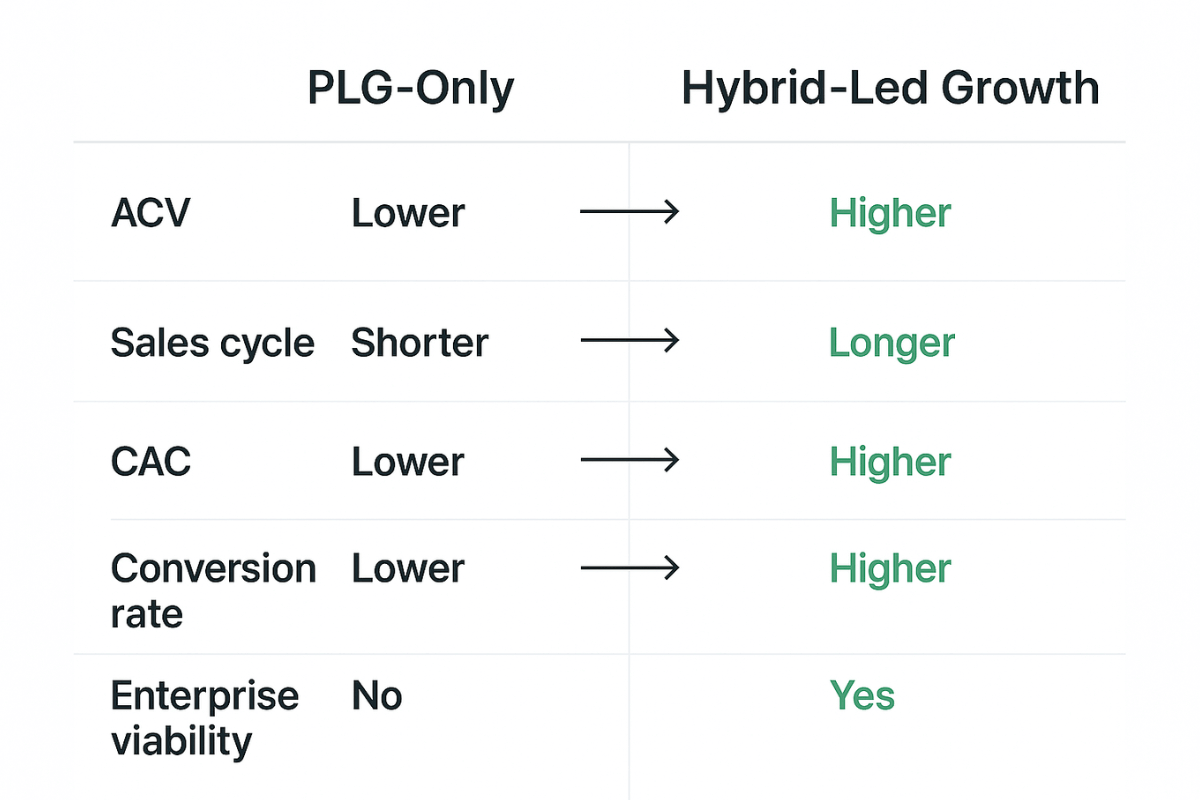
Hybrid-led growth isn't about choosing between product and sales—it's about knowing when each leads. The product creates the foundation and qualifies demand. Sales closes complexity and expands accounts. Together, they compound.
In other words, it's not PLG vs sales-led growth; it's PLG plus sales at the right moment.
The Hybrid Growth Flywheel
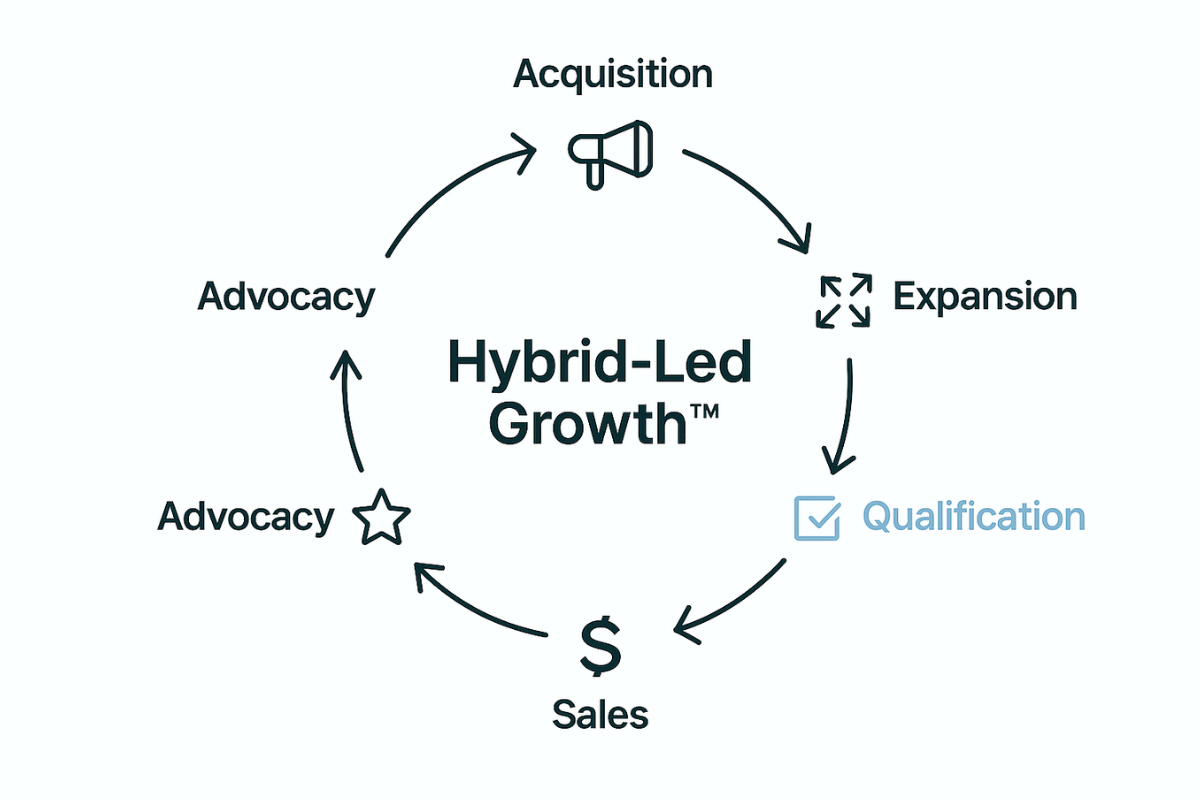
Think of it as a six-stage integrated cycle:
-
Product-Led Acquisition
Freemium or trial experiences drive users into your ecosystem—low CAC, viral mechanics, immediate value delivery.
-
Usage Expansion & Behavioral Data Capture
Which users invite team members? Who connects integrations? Which usage thresholds predict buying intent?
-
Automated Qualification
Convert engaged users into product-qualified leads. As Harsh Jawharkar, former VP Marketing at Atlassian, explains: "PQLs are not generated by themselves. You need to manufacture them by defining experiments and incenting users to take action so they start getting value from your product."
-
Strategic Sales Engagement
Not cold outreach, but warm conversations with users who've already experienced value and demonstrated enterprise potential through their behavior.
-
Enterprise Closing & Expansion
Leverage sales expertise to navigate procurement, customize solutions, and secure executive buy-in. This is where deals grow from $25K to $250K and beyond.
-
Customer Advocacy & Network Effects
Successful enterprise deployments create new viral adoption within organizations and across their networks.
Product does 80% of the work up to a certain ACV threshold. Sales adds 10x value at the enterprise inflection point. Neither works optimally alone.
The Data Proves It Works
Today's PLG leaders validate this model. Sales headcount at these companies now represents 30–45% of total employees—not because PLG failed, but because hybrid succeeded.
These companies maintain:
- 50% annual growth rates (compared to 21% for traditional SaaS)
- Sustainable velocity through hybrid approaches
- Product-led acquisition with sales-led expansion
Case Studies: The Hybrid Transition in Action
The following patterns emerged across multiple B2B SaaS consulting engagements, illustrating the power of hybrid growth:
Pattern #1: The Collaboration Platform (Integration-Triggered Sales)
Challenge: 9% conversion ceiling with extensive enterprise usage in free accounts
Strategy: Integration triggers—when users connected G-Suite or Jira, a strategic sales account executive engaged for team deployment conversations
Results:
- ACV grew from $4,000 (self-serve average) to $12,000+ (sales-assisted)
- Enterprise segment expanded from 15% to 38% of total revenue in 18 months
Key Lesson: Product created the qualification mechanism through integration behavior; sales closed the organizational complexity.
Pattern #2: The Analytics Tool (Freemium as Lead Generation)
Challenge: 50+ enterprises with 100+ free users each, but procurement friction blocked self-serve expansion
Strategy: Added an enterprise sales layer focused specifically on security, compliance, and executive buy-in—using freemium adoption as undeniable proof of value
Results:
- 12 enterprise contracts averaging $75,000 ACV in first year
- 98% retention (compared to 85% for self-serve customers)
Key Lesson: Freemium proved to be a lead-generation engine, not a revenue engine. Sales converted organizational proof-of-value into enterprise commitments.
Pattern #3: The Developer Tool (Bottom-Up Meets Top-Down)
Challenge: Strong individual developer adoption created no path to company-wide standardization
Strategy: Solution selling that bundled multiple products with pitches tailored to CTO and VP Engineering needs around standardization, security, and scale
Results:
- Average deal sizes reached 8x higher than self-serve
- Developers championed from the bottom-up while sales closed the top-down standardization decision
Key Lesson: Product earned trust; sales enabled scale.
Across all three cases, product proved value, generated demand, and qualified buyers. Sales navigated complexity, closed procurement, and expanded accounts. The hybrid model delivered outcomes neither motion could achieve independently.
Your 90-Day Hybrid Growth Playbook
When to Add Sales: The Trigger Checklist
Consider building your sales motion when you observe:
- ☐ Monthly freemium-to-paid conversion plateaued at 8–12% for three or more consecutive months
- ☐ ACV stuck around the $25K median despite clear enterprise user presence in your data
- ☐ 10+ monthly inbound inquiries mentioning "need custom contract" or "can we talk to sales"
- ☐ Churn rate above 3.5% monthly due to lack of success management and account strategy
- ☐ Enterprise prospects identifiable from email domains representing 20%+ of trial signups but under 5% of conversions
Phase 1: Your First Sales Hire (Months 1–6)
Start with a Strategic Account Executive—not a traditional closer.
Focus areas:
- PQLs showing enterprise signals
- Existing freemium power users demonstrating expansion potential
Target: Build toward 30% of total headcount in sales within 18 months (aligns with industry benchmarks at mature PLG companies)
Compensation structure:
- Higher base salary
- Commission tied to retention and expansion metrics, not just new bookings
- Aligns incentives with product-led values around customer success
Phase 2: Team Expansion (Months 7–12)
Add these capabilities:
- Customer Success roles dedicated to enterprise accounts
- PQL scoring system that automates qualification based on:
- Team invites
- Integration connects
- Usage thresholds
- Admin-level actions
- Sales operations role to integrate CRM with product data (sales works from usage intelligence rather than cold outreach)
Phase 3: Specialized Scale (Month 13+)
Build specialized roles:
- Enterprise AEs for six-figure deals
- Mid-market AEs for the $25K–$100K range
- Solutions Engineers for technical validation
Create your "product-led sales" playbook:
- Reps leverage product usage data and product-qualified accounts (PQA)
- No interruption with cold outreach
- Design a self-serve to human-assisted flow that scales
Avoiding the Culture Clash
Many PLG companies resist sales because it can feel like a betrayal of product-first values. Prevent this by designing integration from day one:
The Four Integration Principles
-
Align Sales KPIs with Product Success
Sales metrics must include product adoption (daily active users, feature engagement), not just revenue numbers.
-
Give Product Teams Review Rights
No rogue roadmap promises. The product team has veto power on all feature commitments.
-
Build Shared Dashboards
Product monitors PQL creation; sales tracks conversion. Eliminate information silos.
-
Tie Compensation to Long-Term Success
Sales bonuses partly tied to customer NPS and retention, ensuring alignment with customer success over short-term closes.
Conclusion: Evolution, Not Abandonment
The data doesn't lie:
- 45% year-over-year sales growth at PLG companies
- 30–45% of headcount now in sales roles
- Mathematical ceiling at 9% conversion rates with $25,000 ACV limits
Hybrid-led growth isn't one path among many—it's the only sustainable path to enterprise scale while preserving your product-led foundations.
The companies that pioneered PLG evolved first because they understood this reality. Slack, Dropbox, Atlassian, and Zoom didn't abandon their product-led principles—they completed them with sales infrastructure that could navigate enterprise complexity.
If you're seeing the three symptoms in your growth data, the window for proactive transition is open. Reactive transitions happen when growth stalls completely and investors demand immediate answers. Proactive transitions happen when you're still growing but recognize the ceiling approaching.
The playbook exists. The pattern is proven. The only question is timing.
Frequently Asked Questions
What is product-led growth and why is it changing?
Product-led growth is a go-to-market strategy where the product itself drives acquisition, conversion, and expansion through freemium models, free trials, and self-serve experiences. It's changing because mathematical limits emerge at scale—9% average conversion rates and $25K median ACVs create predictable revenue ceilings that require sales intervention to overcome, especially for enterprise deals requiring procurement navigation and executive buy-in.
How do you know when to add sales to a PLG company?
Add sales when you observe conversion plateaus at 8–12% lasting three-plus months, ACV stuck around $25K despite enterprise usage patterns, regular inbound requests for sales conversations, churn above 3.5% monthly due to lack of account management, and enterprise prospects representing 20%+ of trials but under 5% of conversions.
What is hybrid-led growth in SaaS?
Hybrid-led growth combines product-led acquisition and qualification with sales-led closing and expansion. Product creates the foundation through viral adoption and self-serve experiences, generating behavioral data that identifies product-qualified leads. Sales engages strategically with these warm leads to navigate enterprise complexity, close larger deals, and drive account expansion. Neither motion works optimally alone; together they compound.
How do PLG companies integrate sales teams successfully?
Successful integration requires cultural alignment from day one. Sales KPIs must include product adoption metrics, not just revenue. Product teams need veto power on feature commitments. Build shared dashboards eliminating information silos. Tie sales compensation partly to customer retention and NPS. Focus sales efforts exclusively on product-qualified leads rather than traditional cold outreach, maintaining product-led principles while adding sales capability.
What metrics indicate PLG has hit its revenue ceiling?
Key indicators include free-to-paid conversion plateauing at 8–12% despite optimization efforts, average contract values stuck at the $25K median when usage data shows enterprise potential, minimal expansion revenue due to lack of account strategy, enterprise prospects with recognizable domains signing up but not converting, and increasing inbound requests mentioning the need for sales conversations or custom contracts.