You've seen your product-led growth (PLG) engine deliver impressive early results. Free signups surged. Activation rates climbed. Then something changed.
Conversion rates plateaued. Enterprise deals stalled in procurement. Your Customer Acquisition Cost (CAC) crept upward while revenue growth slowed.
Here's the uncomfortable truth: Only 9% of free accounts convert to paid on average, which makes pure PLG mathematically unsustainable beyond a $20–30K Annual Contract Value (ACV).
Your freemium model isn't broken—it's simply reached its natural ceiling.
The good news? This ceiling is entirely predictable. Three specific metrics reveal exactly when PLG alone can no longer scale your revenue. This article delivers a data-backed diagnostic that shows when to add sales, how to calculate your freemium conversion limit, and why hybrid-led growth becomes financially superior at the inflection point.
The Hidden PLG Revenue Ceiling (Why Freemium Peaks Too Early)
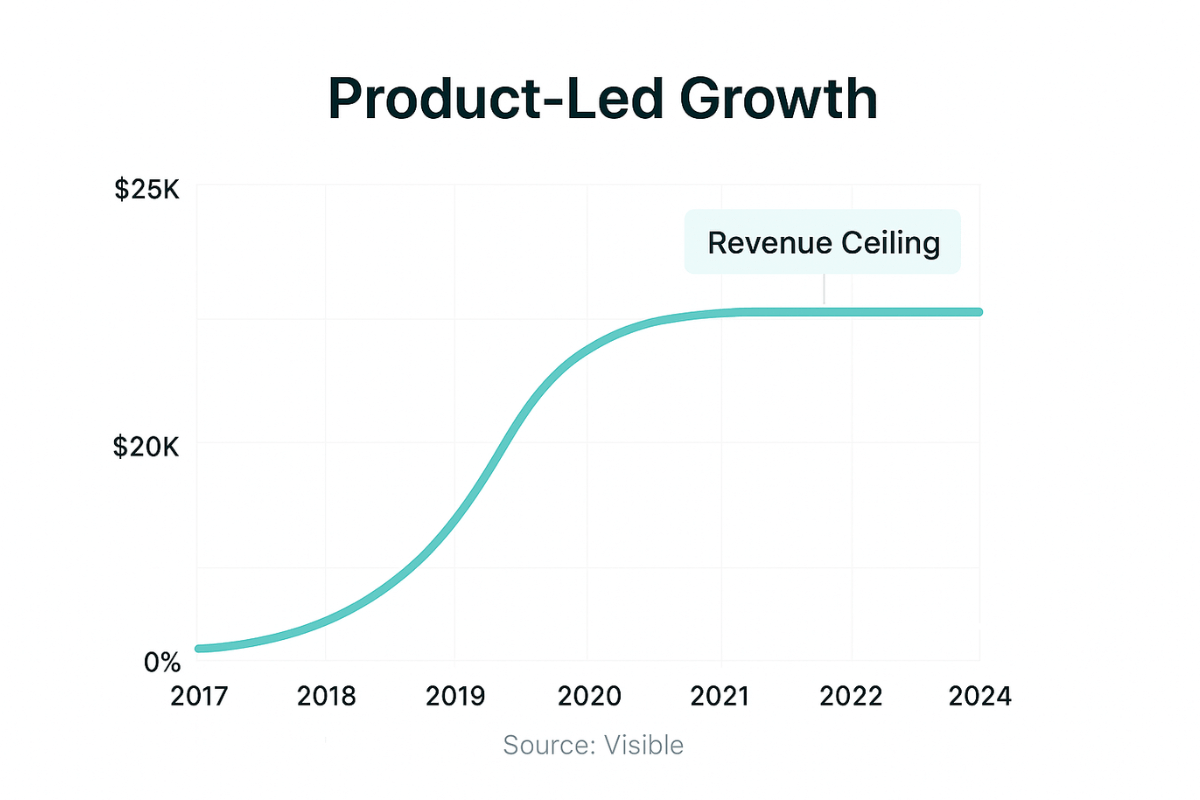
Product-led growth works brilliantly—until it doesn't. The model thrives on volume, low friction, and viral adoption. But there's a mathematical reality most SaaS leaders discover too late: freemium has a built-in revenue cap.
The median ACV for PLG companies sits at $25,000. Beyond this threshold, free-to-play conversion economics collapses entirely.
Why Enterprise Economics Break PLG
Enterprise buyers require security reviews, lengthy procurement processes, and multi-stakeholder approval—a level of friction that self-serve models simply can't overcome.
Consider math. With a 9% conversion rate and 1,000 monthly signups, you generate 90 paid customers. At a $10K ACV, that's $900K in new annual revenue—respectable growth.
Yet scale that ACV to $30K, and suddenly you need three times the conversion rate or three times the signups to maintain the same growth rate. Neither of these components scales linearly in a pure PLG environment.
The Data Behind the Transition
Sales headcount at PLG companies has grown 45% year-over-year since 2017—faster than any other role across the industry. Major players like Slack, Dropbox, and Atlassian all added sales teams despite starting as pure PLG pioneers.
They recognized what the metrics were signaling: human intervention becomes non-negotiable at enterprise ACV.
Quick Diagnostic: Your current free-to-play conversion rate tells you how close you are to this ceiling. If it's below 8%, you're already there.
Symptom #1 — The Freemium-to-Paid Conversion Ceiling
There's a hard, mathematical limit to what acquisition volume alone can deliver. The 9% industry average conversion rate isn't just a benchmark—it's a physical constraint.
To profitably support enterprise-level ACVs, you need conversion rates of 20–30%. That's 2–3 times higher than pure PLG typically achieves.
Why the Gap Exists
Enterprise buyers need:
- Proof of Return on Investment (ROI) before committing substantial budget
- Customization discussions and dedicated account support
- Security certifications and compliance documentation as standard practice
None of these critical friction points disappear through better onboarding or activation emails. They require human conversation.
Calculate Your Revenue Ceiling
Here's your diagnostic calculation:
Monthly signups × Conversion rate × ACV = Annual expansion potential
If that number doesn't exceed $1M, you've hit the ceiling. Your acquisition engine alone can't generate enough qualified demand to sustain growth without direct sales involvement.
The Tier-by-Tier Reality
The conversion ceiling varies across pricing tiers:
- Freemium to starter plan: 15% is achievable
- Starter to professional: 8–10% typical
- Professional to enterprise: Often below 5%
Each tier compounds the challenge.
Calculate your current conversion rate by segment. If your enterprise-tier conversion sits below 10% despite having strong product-market fit, the problem isn't your product. It's the absence of a sales motion designed to close complex deals.
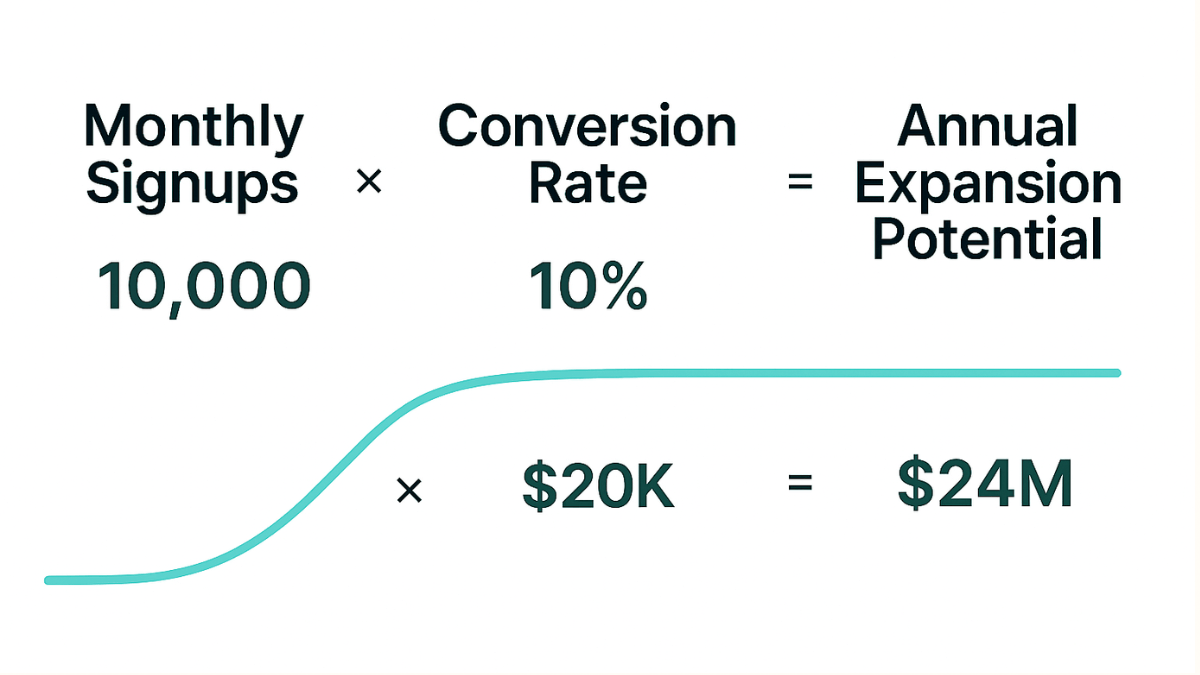
"Only 9% of free accounts convert to paid—making pure PLG mathematically untenable past $20–30K ACV."
Symptom #2 — LTV:CAC Inversion Indicates PLG Alone No Longer Scales
PLG's early advantage is near-zero customer acquisition cost. Content marketing, SEO, and viral growth fuel signups without expensive sales operations. This creates exceptional unit economics—at least initially.
But as you saturate your ideal customer profile and expand into new market segments, your CAC rises:
- Paid acquisition becomes necessary
- Content requires more investment to stand out
- Competition for attention intensifies with every marketing dollar spent
Meanwhile, Customer Lifetime Value (LTV) stabilizes as usage patterns mature and expansion revenue plateaus.
When Economics Flip
When CAC grows faster than LTV, your PLG engine shifts from growth accelerator to profitability drain.
This crossover point typically occurs when your CAC payback period exceeds 12 months—a leading indicator of PLG exhaustion.
Check your metrics closely. If your CAC payback has crossed the one-year mark while LTV remains flat, you're seeing Symptom #2.
How Hybrid Models Reverse the Trend
Sales-assisted deals carry higher upfront costs but consistently generate 2–3× higher ACV. The substantial LTV expansion effectively offsets the necessary CAC increase, restoring healthy unit economics.
The product still drives acquisition at low cost. Sales drives expansion at high value.
Warning Signals: Track your CAC-to-LTV ratio quarterly. A ratio below 3:1 signals deep trouble. A ratio below 2:1 demands immediate intervention.
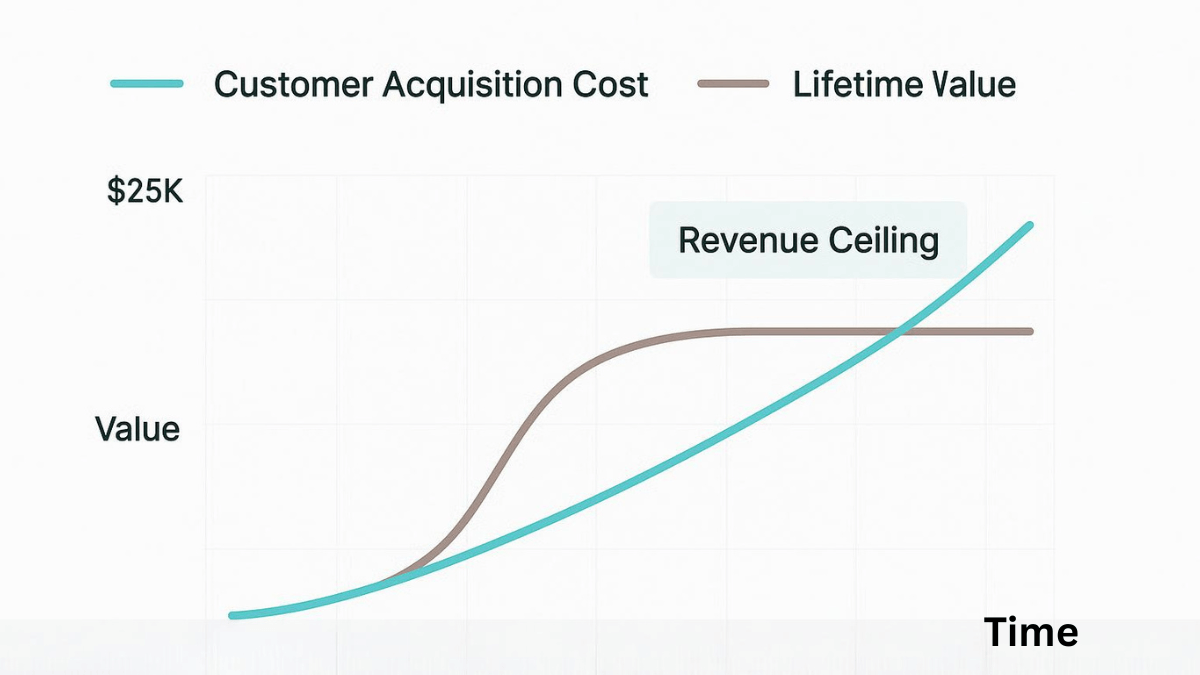
"When CAC grows faster than LTV, your PLG engine shifts from growth accelerator to profitability drain".
Symptom #3 — Sales Headcount Growth Becomes Unavoidable for ACV Expansion
The pattern repeats across all successful PLG companies: rapid early growth through self-serve, followed by strategic sales team buildout.
This isn't a pivot away from PLG. It's an evolution to sustain the growth that PLG started.
The 45% year-over-year sales headcount growth across PLG companies proves this transition is standard practice, not an exception.
Why Sales Hiring Surges
An ACV above $20K almost universally requires sales involvement. Enterprise deals inevitably stall in procurement without human intervention:
- Legal teams demand contract negotiation and redlining
- Security officers require compliance conversations
- Executive buyers need high-touch ROI validation before signing off
These aren't objections your product can overcome alone—they're standard steps in the high-ACV buying process.
The Slack Evolution Blueprint
Slack grew to $100M in Annual Recurring Revenue (ARR) on a pure PLG foundation, then successfully added enterprise sales to reach $1B ARR.
The core product didn't change—the go-to-market motion did.
Self-Assessment: If your largest deals consistently stall at legal review or security assessment, you've already hit the ceiling. The deal isn't lost because of a product feature—it's stuck because there's no one to move it forward.
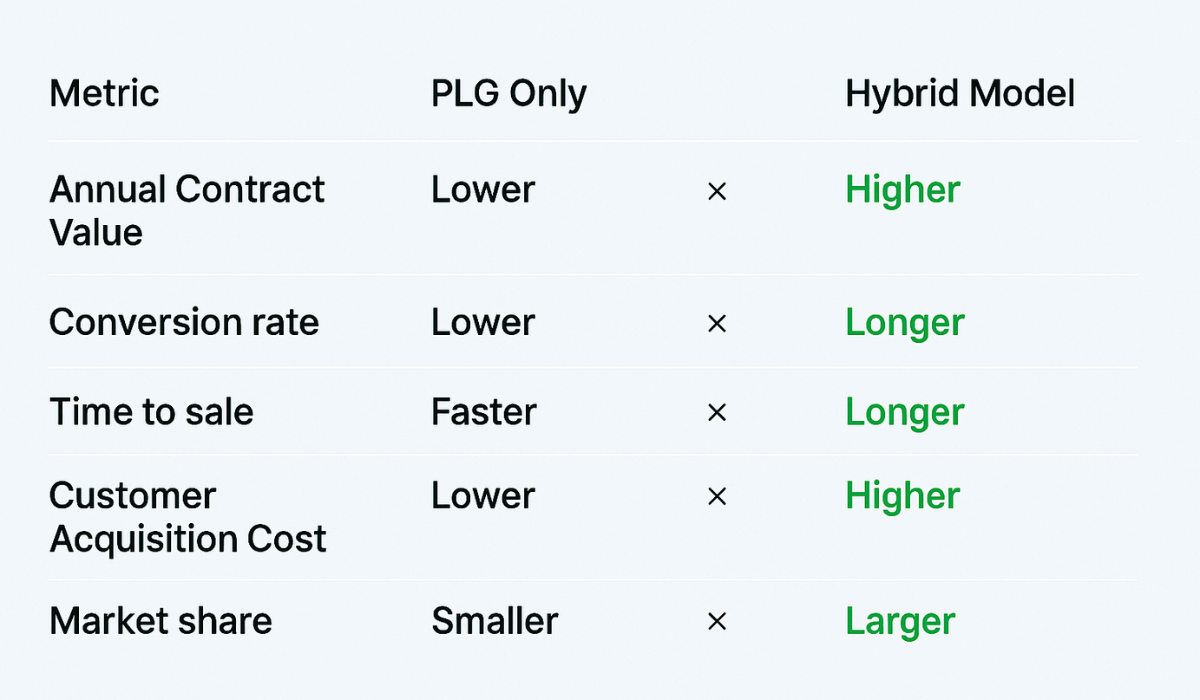
"The 45% year-over-year sales headcount growth across PLG companies proves this transition is standard practice, not an exception."
The PLG Inflection Point: When These 3 Symptoms Converge
One metric alone is noise. Three converging metrics form a clear roadmap.
The inflection point becomes undeniable when these conditions align:
- ACV exceeds $20–25K
- Free-to-play conversion drops below 10%
- CAC is rising while LTV flattens
Each symptom alone suggests a problem. Together, they confirm you've reached the limit of what PLG alone can profitably deliver.
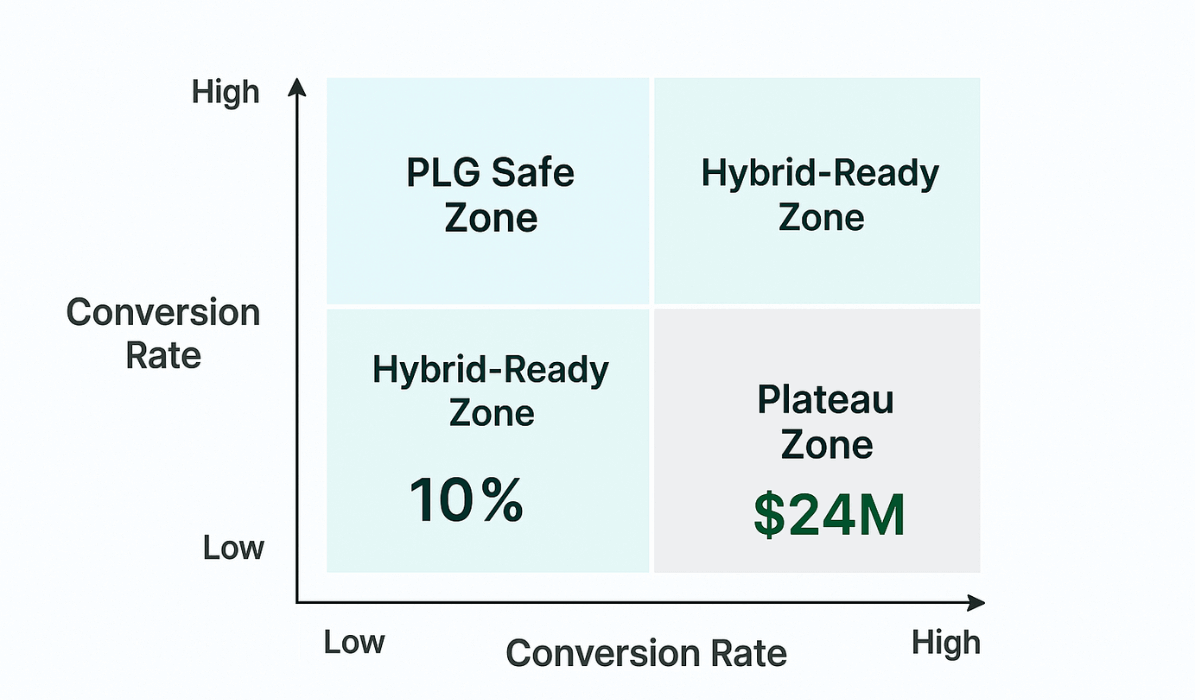
The Diagnostic Matrix
This convergence is predictive, not reactive.
If you're at $15K ACV with 12% conversion and stable CAC, you still have runway. But if ACV is climbing toward $25K and conversion is drifting below 10%, the inflection is approaching fast.
Simple diagnostic: Plot your ACV on one axis and your conversion rate on the other.
- Low ACV + High conversion = PLG safe zone
- High ACV + Low conversion = Hybrid-ready (act now)
- High ACV + High conversion = Either a unique market position or potentially misreported metrics
Why Timing Matters Critically
Hybrid-led growth becomes financially superior the moment these symptoms converge.
The cost of not adding sales—stalled pipeline, lost enterprise deals, competitive displacement—far exceeds the investment required for sales hiring.
Add sales too early, and you undermine PLG efficiency. Add sales too late, and you sacrifice 12–18 months of vital growth.
The three metrics tell you exactly when the shift must happen.
Hybrid-Led Growth: The Only Sustainable Path Beyond the Ceiling
Hybrid doesn't mean abandoning PLG. It means enhancing what's already working and fixing what isn't.
The product continues driving acquisition through free trials, freemium tiers, and viral growth. This motion efficiently captures volume at low blended CAC.
Sales steps in where the product cannot close alone—specifically for enterprise deals, complex implementations, and multi-stakeholder buying committees.
The Result: Superior Economics
- Lower blended CAC
- Higher realized ACV
- Product generates high-volume demand
- Sales captures high-value conversions
The Hybrid Evolution Pattern
Dropbox, Figma, Atlassian, and Zoom all followed this exact path. None abandoned their product-led roots—they augmented them with a sales motion where high-value engagement was necessary.
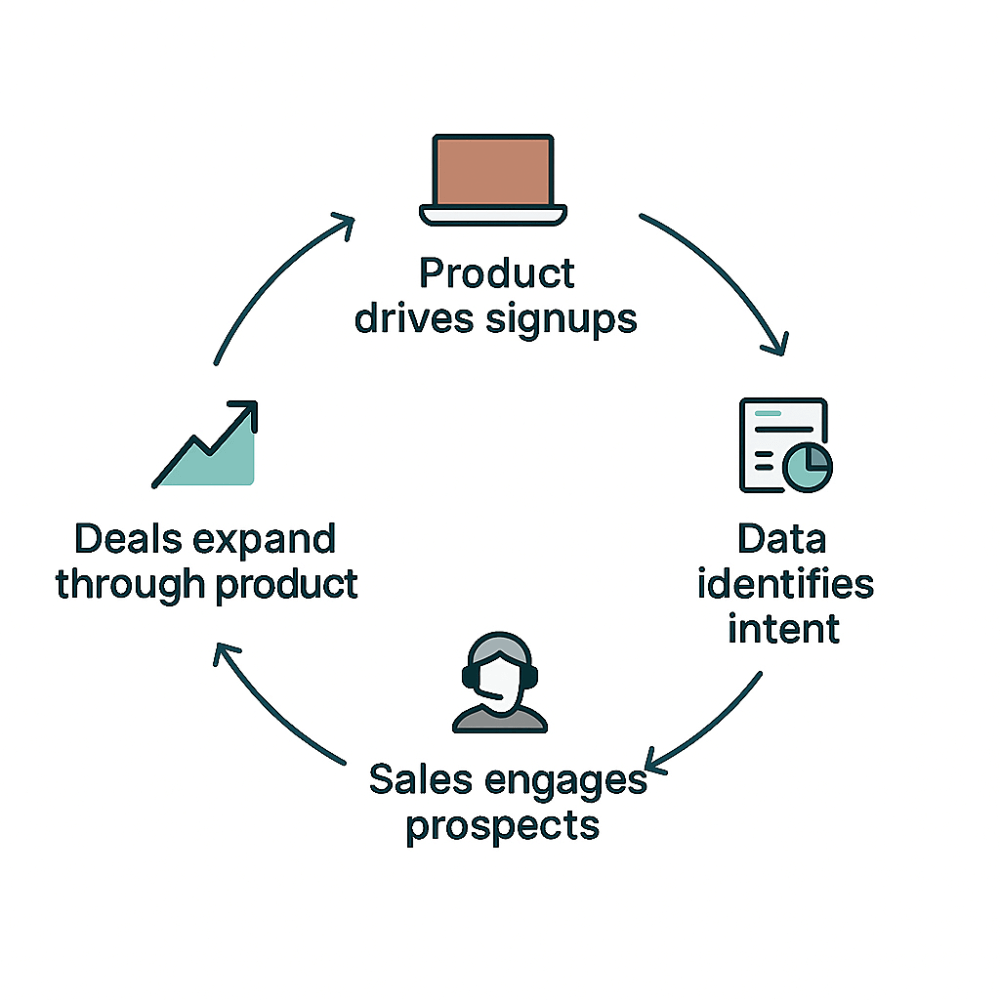
The Hybrid Flywheel
- Product drives signups at scale
- Usage data identifies high-intent accounts
- Sales engages qualified prospects with personalized support
- Closed deals expand further through product-led upsells
Each motion reinforces the other.
Strategic Question: What breaks first in your funnel as you attempt to scale? If it's conversion at higher ACV, that's your hybrid entry point. If it's expansion revenue, sales should focus on upsells and account management. If it's enterprise deal velocity, sales should accelerate complex cycles.
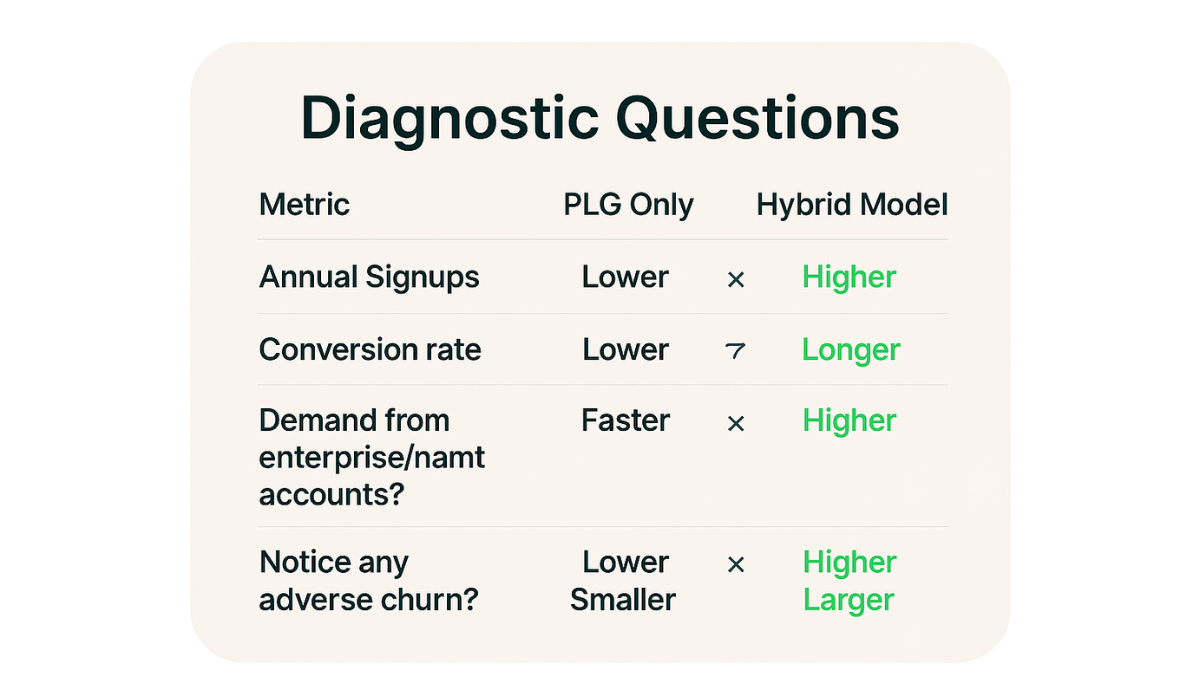
The Freemium Ceiling Diagnostic — 5 Questions to Determine Your Readiness
Use this checklist to assess your GTM readiness for a hybrid model:
- ☐ Is your free-to-play conversion rate below 10%?
If yes, acquisition volume alone can't sustain growth at enterprise ACV. - ☐ Is your ACV above $20K with no clear expansion engine?
If yes, you're approaching the natural limit of self-serve economics. - ☐ Do enterprise deals consistently stall at security, legal, or procurement?
If yes, your buying process requires human facilitation. - ☐ Is CAC rising while feature adoption remains flat?
If yes, you're experiencing diminishing returns on your PLG investment. - ☐ Are usage-based upsell paths flattening despite product improvements?
If yes, expansion requires sales-led account management.
Your Score
- 3+ yes answers: You've hit the ceiling
- 2 yes answers: You're approaching it rapidly
- 1 or fewer: You still have PLG runway
This diagnostic reveals not just whether you need sales, but precisely where to focus them:
- Security stalls → Sales with technical expertise
- Procurement delays → Salespeople with facilitation skills
- Flat expansion → Account management focus
Conclusion — The Ceiling Is Predictable. Your Response Should Be Too.
PLG revenue ceilings are not random occurrences—they are diagnosable with three consistent metrics: conversion rate, LTV:CAC dynamics, and ACV thresholds.
When these three metrics converge unfavorably, hybrid-led growth becomes the only viable path to sustained scale.
The companies that recognized this transition early—Slack, Dropbox, and Atlassian—successfully broke through their ceilings and became category leaders. The companies that waited too long—or ignored the symptoms—plateaued.
Your current metrics are already telling you the full story of your growth potential. The question is whether you're listening to the data.