Degree requirements have dropped by 7–9 percentage points in AI-exposed roles. Yet 66% of tasks through 2030 will still demand human judgment, creativity, and ethical reasoning. If your hiring signals haven't adapted to this shift, your organization is already behind.
Most teams still screen primarily for credentials. The best, however, are shifting toward assessing AI-complementary human capabilities—skills that determine performance in hybrid environments. This guide walks through a practical, measurable framework for an AI-driven reskilling strategy in recruitment. You'll see how capability-based hiring improves signal quality, reduces mis-hires, strengthens time-to-productivity, and increases retention.
You'll also find a scorecard template, evidence-backed capability definitions, and a 30/60/90 rollout plan to help you shift from credential bias toward clarity on real capability.
Why Hiring Signals Are Collapsing (And Why It Matters)
The collapse of credential-based hiring isn't theoretical—it is already unfolding. Between 2019 and 2024, degree requirements fell 7 points for AI-augmented roles and 9 points for roles with rising automation exposure. At the same time, the skills hierarchy inside AI-exposed occupations is evolving 66% faster than just two years ago.
As a result, the shelf-life of a "relevant credential" is shrinking month by month.
This collapse directly affects your hiring signal quality. Resume screens now capture fewer true high-performers and more false positives—candidates who appear strong on paper but lack the judgment, adaptability, or emotional intelligence required to excel in human–AI hybrid environments.
The Cost of Signal Decay
- 89% of recruiters say bad hires fail due to soft-skill gaps, not technical weaknesses.
- Low emotional intelligence is the second most common reason new hires do not reach the 18-month mark.
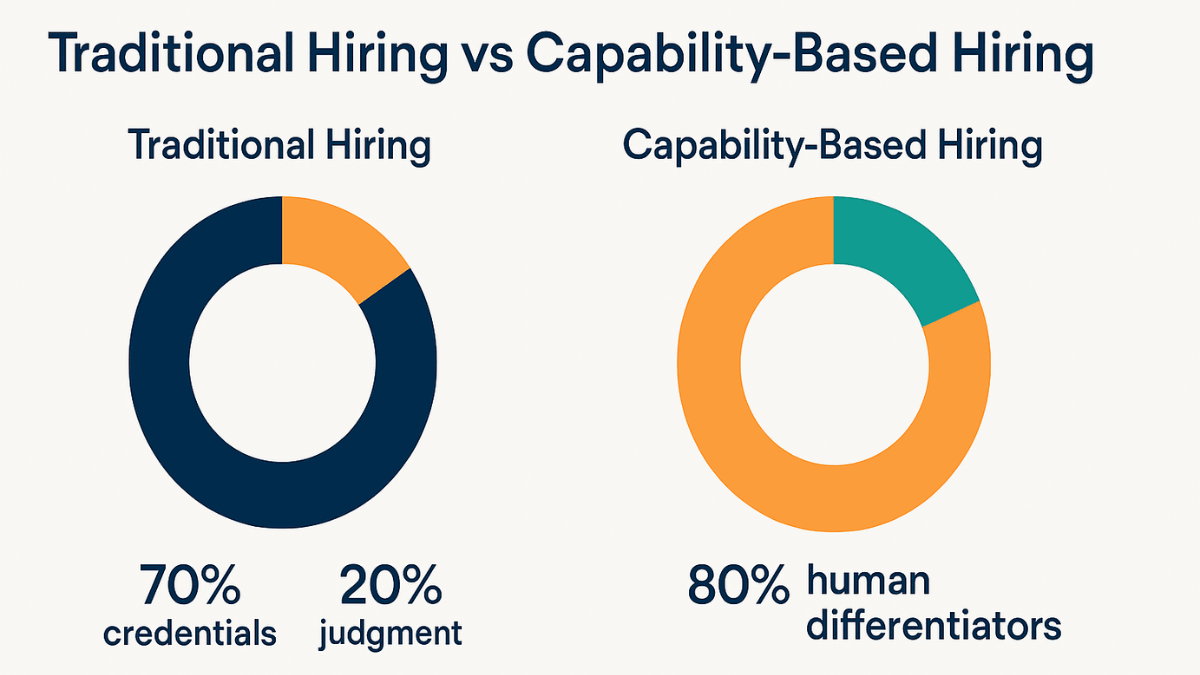
- Despite this, most hiring processes still weight credentials at 70% and judgment at just 20%.
This skew persists because credentials are easy to verify and quick to filter. Judgment, in contrast, is harder to measure—yet nowhere near impossible. What's required is a capability-based hiring framework that evaluates the human differentiators driving performance in an AI era.
The Five Irreplaceable Human Capabilities for AI Roles
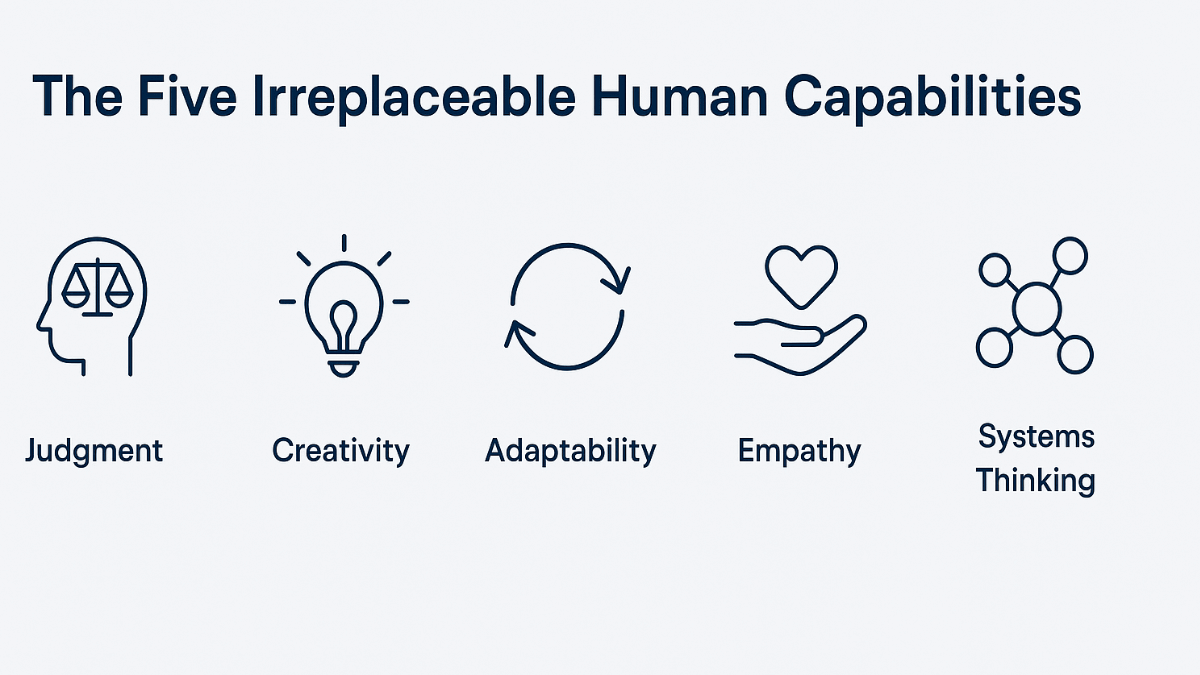
Not all human skills carry equal value in AI-enhanced work. According to the WEF's Future of Jobs Report 2025, five human capabilities consistently predict performance in augmented roles. These form the core of high-value judgment skills for AI-era hiring.
1. Creative Thinking: Problem-Framing Over Problem-Solving
AI excels at solving defined problems, but only humans can determine which problems are worth solving. In augmented teams, strong creative thinkers shift from execution to strategy. They ask:
- "Should we build this?"
- "What problem are we actually solving?"
Harvard research shows creative problem-framing predicts three times greater impact in roles where humans guide AI. This makes creative thinking a primary differentiator in hiring.
2. Analytical Thinking: Judgment Under Uncertainty
High-performing analysts don't simply interpret AI-generated outputs—they challenge them. They ask what the analysis might be missing, question assumptions, and adjust decisions based on context.
WEF data ranks analytical thinking—defined as real-world judgment under uncertainty, not just math skills—as the second fastest-growing capability through 2030.
3. Emotional Intelligence (EQ): The 2x Performance Multiplier
EQ predicts performance twice as well as IQ and technical skills combined. In human–AI collaboration, EQ becomes even more important because humans manage ambiguity, resolve exceptions, and maintain trust with stakeholders.
Teams with high-EQ members experience:
- 24% higher engagement
- 35% fewer errors
- 18% higher customer NPS
4. Resilience & Adaptability: Learning Velocity
By 2030, 39% of skills will have changed. The differentiator is not what someone knows today—it's how quickly they can learn tomorrow. Yet many hiring processes still emphasize "relevant experience," which reflects the past instead of "learning velocity," which predicts the future.
5. Leadership & Collaboration: Multiplying Through Others
In augmented environments, individual excellence matters less than a person's ability to elevate the performance of the entire team. Collaboration effectiveness increased 52% in cross-functional teams led by strong leaders. This capability is crucial when humans and AI must work together to produce coherent outcomes.
Technical Skills as Threshold Competencies (Not Differentiators)
In the AI era, technical skills remain essential—but only up to a certain threshold. AI literacy, data fluency, and role-specific tool proficiency must be verified as baseline competencies. However, once a candidate clears that threshold—e.g., they can write SQL, run a model, or navigate Tableau—additional technical depth does not predict higher performance.
This is the classic law of diminishing returns.
For hiring, that means:
- Establish a clear technical minimum per role
- Verify that floor early
- Then shift most of the evaluation toward the human differentiators that truly drive ROI
This pivot ensures training budgets and hiring energy focus on capabilities—judgment, EQ, adaptability—where the strongest, most reliable performance gains originate.
The Augmentation Dividend: Why This Hiring Model Drives ROI
Theoretical benefits only matter if they translate into measurable impact. Here, the data is unambiguous.
PwC's analysis of one billion job ads found that workers with human + AI skills command a 56% wage premium (up from 25% in 2024). McKinsey reports 66% productivity gains when teams combine AI tools with human capability development.
Most importantly, the ROI compounds only when teams hire for both simultaneously:
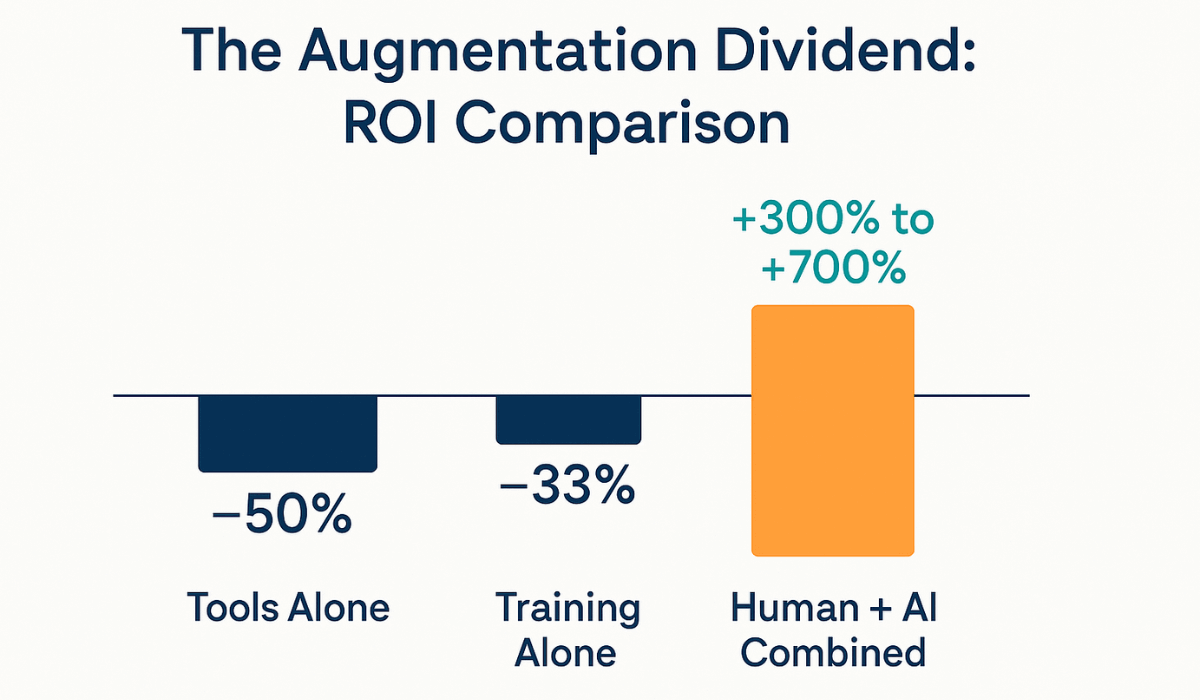
- AI tools alone: ROI falls ~50%
- Training alone: ROI falls ~33%
- Tools + capability-based hiring + training: 300–700% ROI in 12 months
This is the heart of the Augmentation Dividend:
Better hiring signals → stronger hybrid performers → higher productivity → lower turnover → $15k–$22k additional revenue per employee annually → multiplied by AI acceleration.
For a 100-person team, capability-based hiring can unlock $1.5–$2.2 million in annual value.
The Human + AI Hiring Scorecard: A Measurable Framework
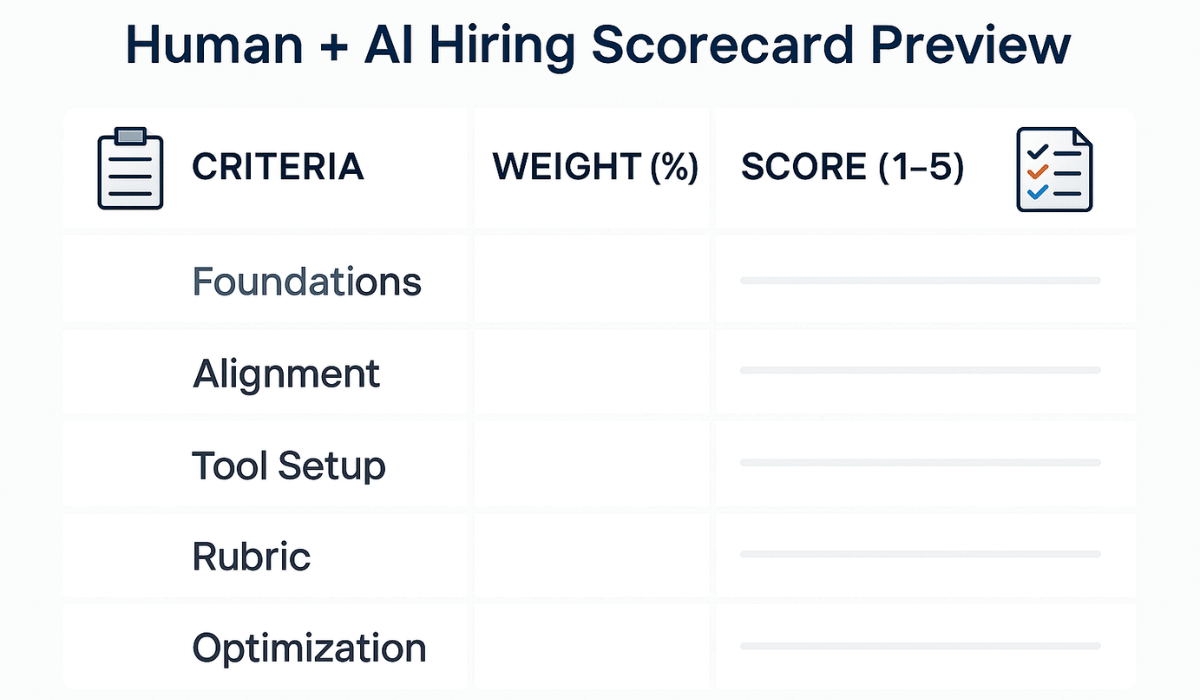
How do you actually measure these capabilities? The Human + AI Hiring Scorecard provides a structured, evidence-based way to evaluate AI-complementary skills with consistency and fairness.
1. Role Profile & Context
Define the role's augmentation model clearly:
- Which tasks will AI automate?
- Which decisions remain human?
- Where do humans and AI collaborate in workflows?
This alignment prevents mis-hiring by clarifying what the role actually requires.
2. Criteria & Weighting
Assign a weight to each capability based on role demands:
- Technical baseline: 20%
- Creative thinking: 15%
- Analytical judgment: 15%
- EQ & collaboration: 20%
- Learning velocity: 15%
- AI fluency: 15%
Weights ensure evaluation stays anchored to the role's actual performance drivers.
3. Evidence Sources (The Critical Shift)
Move beyond resume keyword checks toward predictive sources such as:
- Work samples or portfolios
- Situational judgment tests
- Behavioral interviews
- Reference calls focused on team impact
- AI fluency verification
These data points consistently outperform credentials.
4. Scoring Rubric
Define what "excellent," "good," and "acceptable" look like for each capability.
Example: Creative Thinking
- Excellent: Reframes problems, challenges assumptions, proposes novel approaches
- Good: Understands brief, applies standard methods clearly
- Acceptable: Follows process with limited original thinking
5. Decision Rules
- Technical baseline is pass/fail
- Weighted criteria determine ranking
- Tie-breaks are predefined
- Bias monitoring ensures fairness across demographic groups
This structure reduces subjective drift while improving consistency and quality of hire.
Three Real Candidate Vignettes (Before & After the Scorecard)
To illustrate how the scorecard improves hiring signal quality, here are three short comparisons. These are not success stories—they are diagnostic examples showing how capability-based screening changes decisions.
Candidate A — The High-Credential Applicant Who Underperformed
Before: An applicant with top-tier degrees and multiple certifications advanced rapidly in ATS screening.
After: Their creative thinking assessment landed in the 25th percentile, their situational testing showed limited judgment under uncertainty, and their references highlighted difficulty with stakeholder alignment. Through the scorecard lens, this candidate met the technical floor—but lacked the Tier 2 differentiators required for success. Previously, they would have been hired. Under the new model, they became an informed "no."
Candidate B — The Nontraditional Applicant Who Excelled
Before: A candidate without a formal degree was screened out in a credential-heavy process.
After: With the capability-based approach, their portfolio, judgment scenarios, and collaboration feedback showed strengths across Tier 2 skills. Their AI fluency test demonstrated practical hybrid workflow experience. They scored in the top 15% overall and were hired.
Candidate C — The Mid-Level Performer With High Upside
Before: This candidate appeared average on paper but demonstrated strong learning velocity and adaptability.
After: The scorecard revealed potential for rapid upskilling and future leadership. Their strengths in EQ and creative judgment compensated for modest technical depth. They were hired and became a standout performer within six months.
These vignettes underscore why capability-based hiring improves signal quality: it captures the performers traditional screening misses and filters out those credential screens overvalue.
30/60/90-Day Rollout: How to Implement the Scorecard
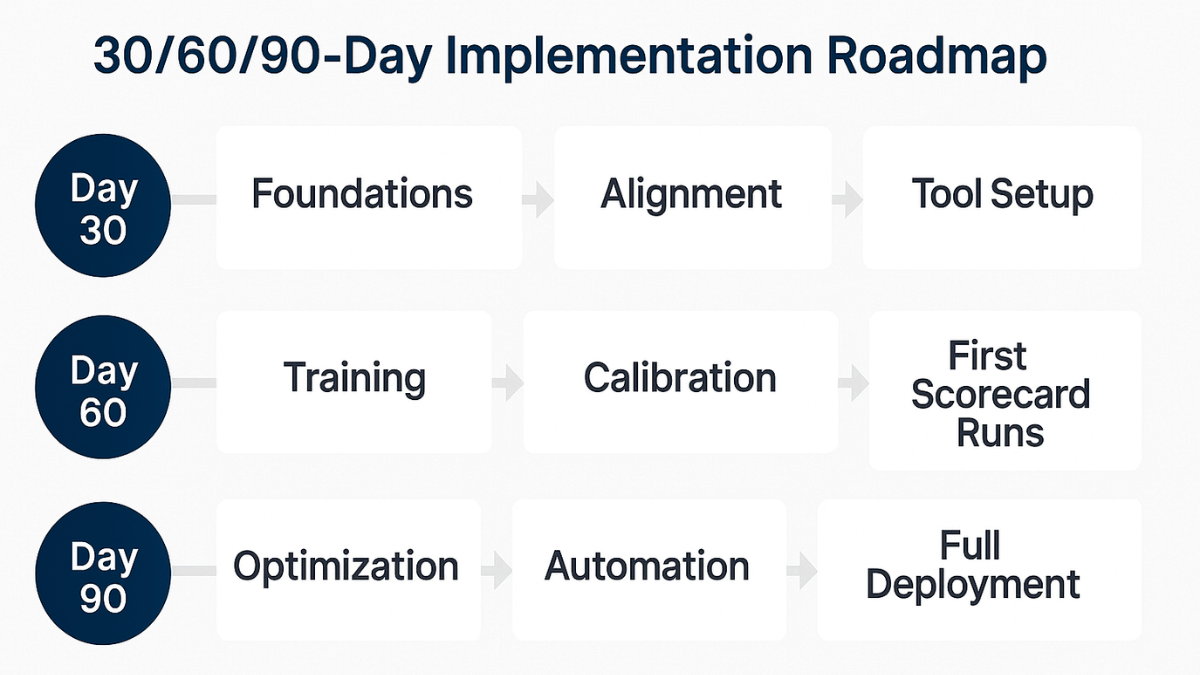
This rollout plan ensures the hiring model becomes operational without overwhelming existing teams. Each stage builds on the last, increasing clarity and consistency.
Days 1–30: Alignment & Calibration
Focus: Clarity over volume
Key Actions:
- Define which roles require immediate calibration
- Align leaders on the capability model
- Document the technical baseline for each role
- Train hiring managers on the five critical capability definitions
Outcome: A shared understanding of what "great" looks like in AI-augmented roles.
Days 31–60: Pilot & Evidence Collection
Focus: Proof of concept
Key Actions:
- Pilot in two to three functions
- Collect work samples and run judgment tests
- Compare candidate quality between old and new methods
- Conduct calibration discussions after each hiring round
Outcome: Practical evidence of improved signal quality and clearer hiring decisions.
Days 61–90: Scale & Optimize
Focus: Enterprise expansion
Key Actions:
- Expand to additional roles
- Train recruiters on structured interviews
- Build bias-monitoring dashboards
- Establish quarterly recalibration cycles
Outcome: A consistent, high-signal hiring process aligned with AI-era capability needs.
The KPIs That Predict Success (10-Metric Scorecard)
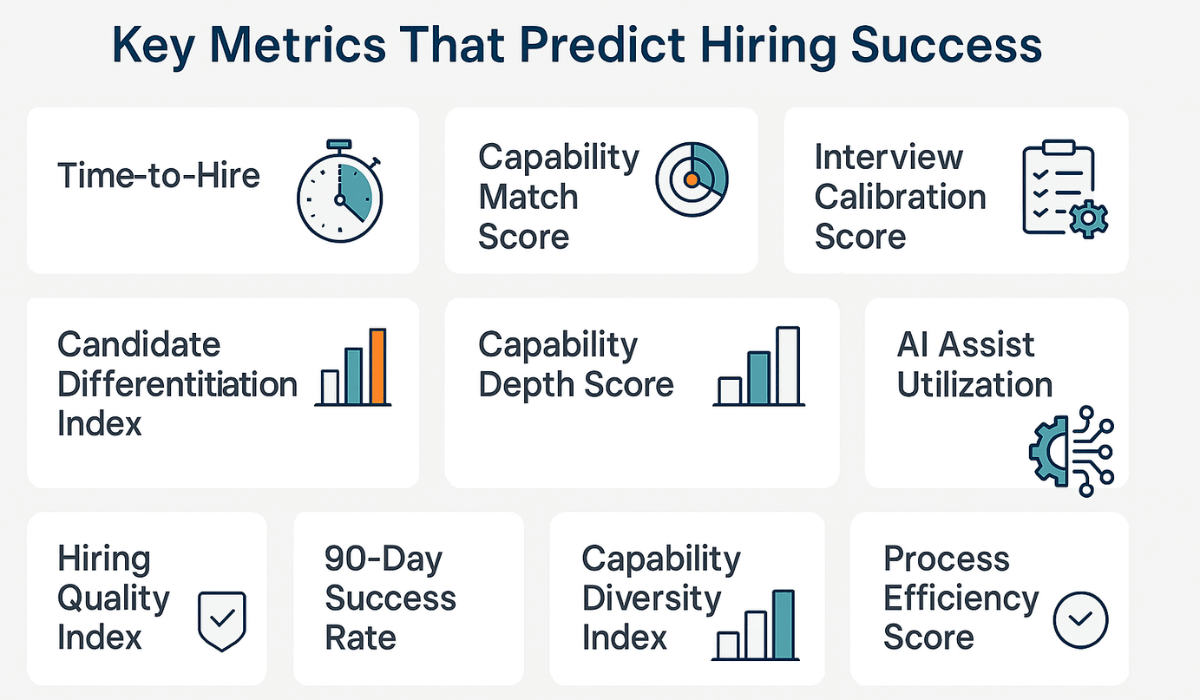
A hiring process is only as strong as its measurement system. These ten metrics help teams diagnose strengths, spot risk early, and continually improve signal quality.
- Technical Baseline Pass Rate — Tracks how many candidates meet the necessary threshold before deeper evaluation
- Tier 2 Capability Scores — Measures the differentiators: creative thinking, analytical judgment, EQ, adaptability, collaboration
- Learning Velocity Indicators — Assessed through test performance and past behavior patterns
- Work Sample Completion Quality — Evaluates clarity, originality, and strategic reasoning
- AI Fluency Verification — Ensures candidates can work effectively in hybrid environments
- Candidate-to-Offer Ratio — Indicates signal quality and funnel health
- Quality of Hire (90-Day & 180-Day) — Performance, engagement, and judgment indicators
- Manager Satisfaction Scores — Feedback on new hire contribution and team fit
- Time-to-Productivity — Measured by output speed, decision quality, and role clarity
- First-Year Retention — A proxy for alignment, capability match, and onboarding quality
Conclusion: A Practical Reset for Hiring in the AI Era
Most hiring systems were built for a pre-AI world—one where experience and credentials were reasonable predictors of performance. That world no longer exists.
Today's hybrid human–AI environment rewards creativity, judgment, emotional intelligence, learning velocity, and leadership. These capabilities drive real value across teams, and they compound when paired with AI-augmentation skills.
The Human + AI Hiring Scorecard doesn't replace your hiring process—it sharpens it. It gives teams clearer signals, reduces mis-hires, supports stronger onboarding, and helps organizations build a workforce designed for 2025 and beyond.
Adopt the model, calibrate it carefully, and your hiring will shift from credential-biased to capability-led—unlocking the full productivity potential of augmented talent.