
Every product in your category now has a copilot. According to the 2025 SaaS Benchmarks Report by High Alpha — drawing on data from over 800 SaaS companies — 92% have either launched AI features or placed them on their roadmap, and 64% now embed AI as a supporting feature.
The companies that shipped fastest are not more defensible than the companies that shipped last. They are equally replicable.
The race to add AI features is over. The race to build products that compound intelligence has barely begun — and if your current AI SaaS product strategy still centers on copilot features, your roadmap may not yet know it's losing.
There is a distinction worth making precise before your next board meeting. The board's question — "do we have an AI strategy?" — is not the same question as "do we have AI features?" Most B2B SaaS companies at $30M–$70M ARR have answered yes to the second and left the first structurally unanswered.
What the board is actually asking, in language they don't yet have, is: does your product accumulate intelligence advantage over time, or does it stay roughly as smart as the day it shipped?
The answer determines whether your AI investment builds a compounding competitive moat or an expensive feature list any competitor can clone in a sprint. This article introduces two frameworks — the AI Data Flywheel and the AI Feature vs. AI Product Spectrum — that give CPOs and founders a precise architectural test for which side of that line their current roadmap sits on.
The Architectural Test: AI-Enhanced vs. AI-Native SaaS
An AI-native SaaS product is defined by an architectural property, not a UI pattern, a feature set, or a model quality claim. "AI-native" has been used to describe enough bolt-on chatbots that it has nearly lost meaning — so the distinction is worth making exact before evaluating any roadmap against it.
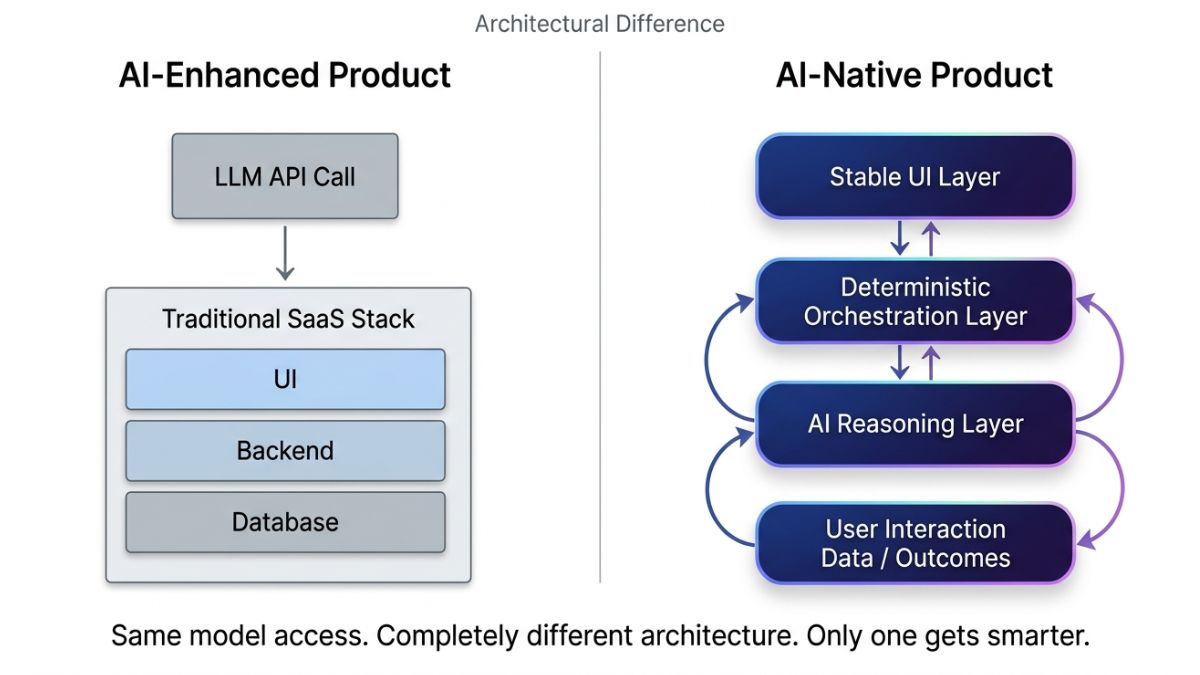
An AI-enhanced product adds AI as a layer to an existing architecture. When a customer uses it, the output depends on the foundation model and the prompt engineering. The product does not get smarter from the interaction. Switch to a different model tomorrow and your product behaves differently — but not necessarily worse — because nothing in your architecture was learning from the customer.
An AI-native product is designed from the start to capture structured outcome data from every customer interaction and feed it back into model improvement. The product gets measurably smarter with use. Switch to a different model and you don't just change a behavior — you lose the accumulated intelligence of your customer base. That asymmetry is the moat.
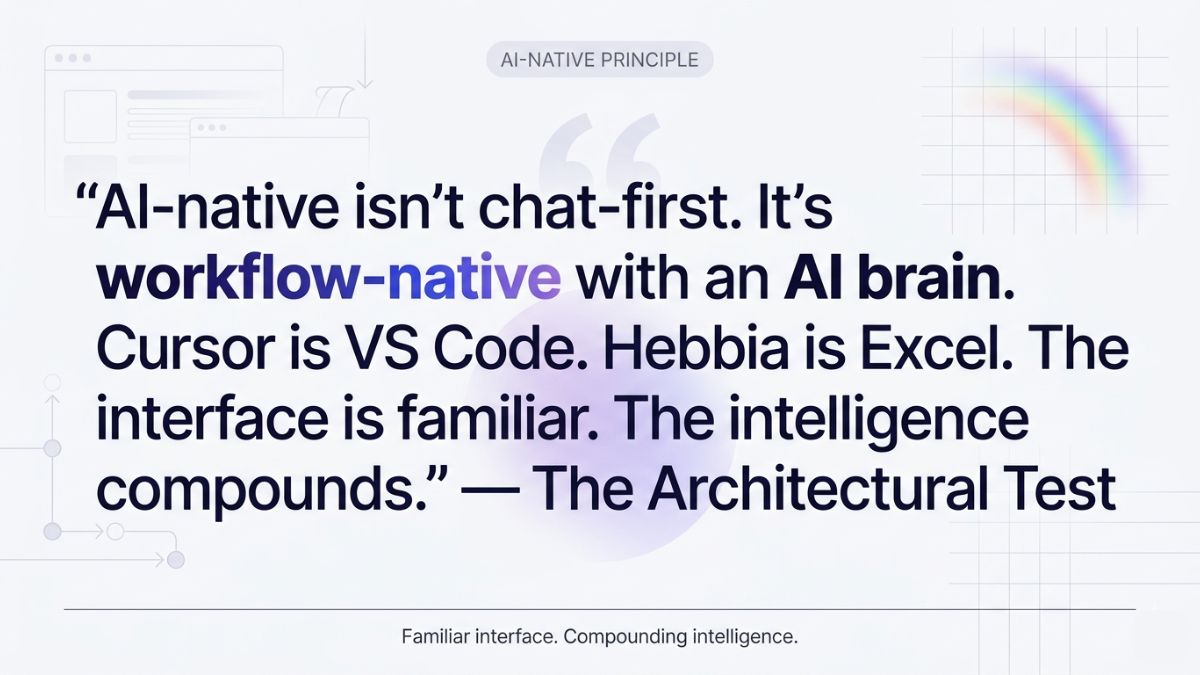
One misconception CPOs consistently express: AI-native requires abandoning structured product interfaces for conversational ones. Two widely cited production examples challenge this directly. Cursor — which crossed $1 billion in annualized revenue in November 2025, roughly two years after its public commercial launch — is, structurally, a fork of VS Code. It is a familiar code editor with AI operating at the logic layer; every VS Code extension still works. Hebbia operates through a table-based document analysis interface — a structured, grid-like format where AI processes reasoning invisible to the user.
In both cases, the interface is familiar SaaS. The intelligence compounds in the infrastructure beneath it. AI-native isn't chat-first — it's workflow-native with an AI brain.
The correct architectural model is three layers:
- A stable, structured UI that users trust and adopt
- A deterministic orchestration layer that routes execution reliably
- An AI reasoning layer that operates on the output and feeds structured data back into the learning pipeline
The CPO building structured product UI while worrying they're "failing the AI-native promise" is building the right thing. The AI reasoning layer is what needs to compound — and that compounding is invisible to the user.
The AI Data Flywheel: How Products Get Smarter — and Why Most Never Do
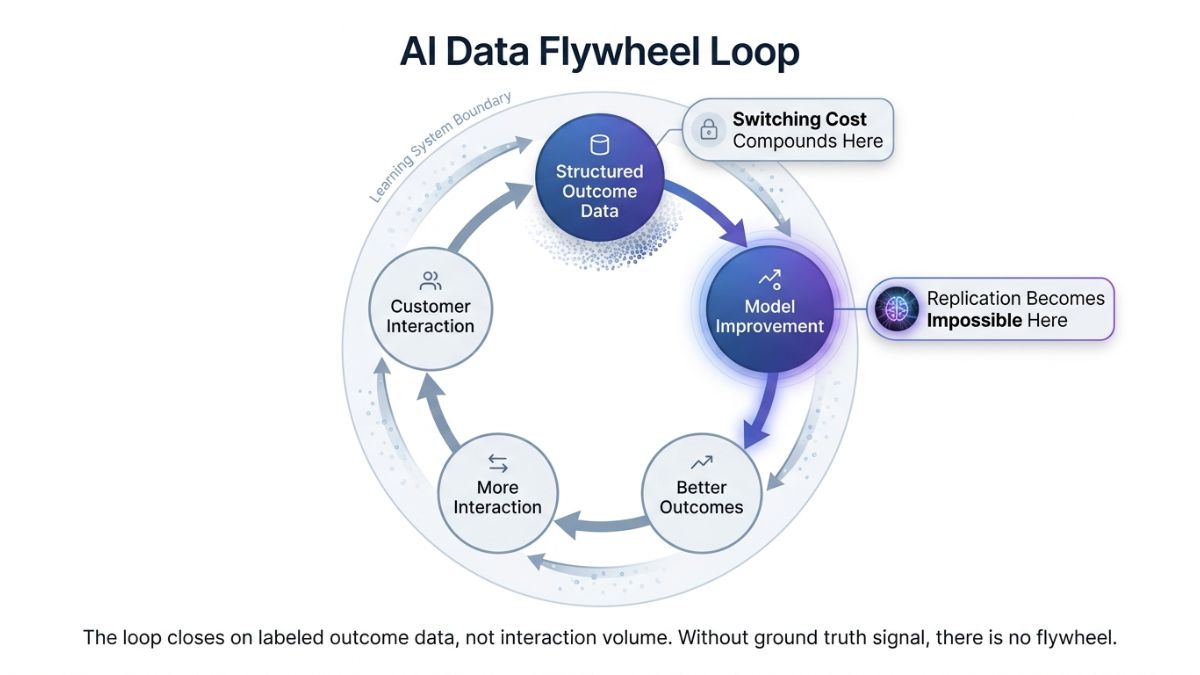
The data flywheel is the mechanism that converts customer usage into compounding architectural advantage. Understanding where most products break it is the difference between building a moat and building a feature.
The loop runs five stages:
- Customer interaction generates structured outcome data
- That data improves the model
- The improved model produces better outcomes
- Better outcomes drive more interaction
- More interaction generates more structured outcome data
Each rotation tightens the loop.
The word "structured" is load-bearing. Unstructured interaction logs — the clickstreams, session replays, and API call histories that most SaaS products already captured — do not feed a flywheel. They describe what happened. The flywheel requires outcome labels: did the AI's output achieve the desired result? Did the customer accept the suggestion or override it? Was the generated response accurate, or did the user correct it? This ground truth signal is what retrains the model. Without it, you have a log file, not a learning loop.
It is also worth naming a common architectural dead end: retrieval-augmented generation (RAG) alone does not constitute a flywheel. RAG improves response accuracy by grounding outputs in current documents — but unless those retrieval decisions and their outcomes are labeled and fed back into training, the system does not improve from use. The flywheel requires the feedback pipeline, not just the retrieval layer.
Capturing structured outcome data requires product decisions made at inception: what to label, how to surface ground truth, how to build the feedback pipeline that moves labeled data back into training. These decisions are prohibitively difficult to add after the fact. Retrofitting them onto an existing product requires redesigning the data model, changing the interaction layer to surface outcome signals the original architecture never captured, and building training infrastructure simultaneously while maintaining product stability. The work is not technically impossible; it is prohibitively disruptive given the architectural cost and timeline it requires.
That disruption cost is zero for an AI-native startup. They designed the flywheel at inception, because there was no existing architecture to redesign against.
The switching cost mechanism follows directly. Building a genuine intelligence moat requires training custom model versions with thousands of proprietary input/output examples, then structuring the product architecture around that custom model core. Each customer's interaction history trains a model version that reflects their specific workflows, edge cases, and outcomes. That personalized model — in practice, a fine-tuned or heavily adapted version of the foundation model — exists only in your system.
A competitor with the same foundation model and API access cannot replicate it, not because of lock-in mechanics, but because the data that makes it valuable exists only in your infrastructure. The switching cost compounds with every interaction.
The AI Product Roadmap Spectrum: Four Stages from Feature to Moat
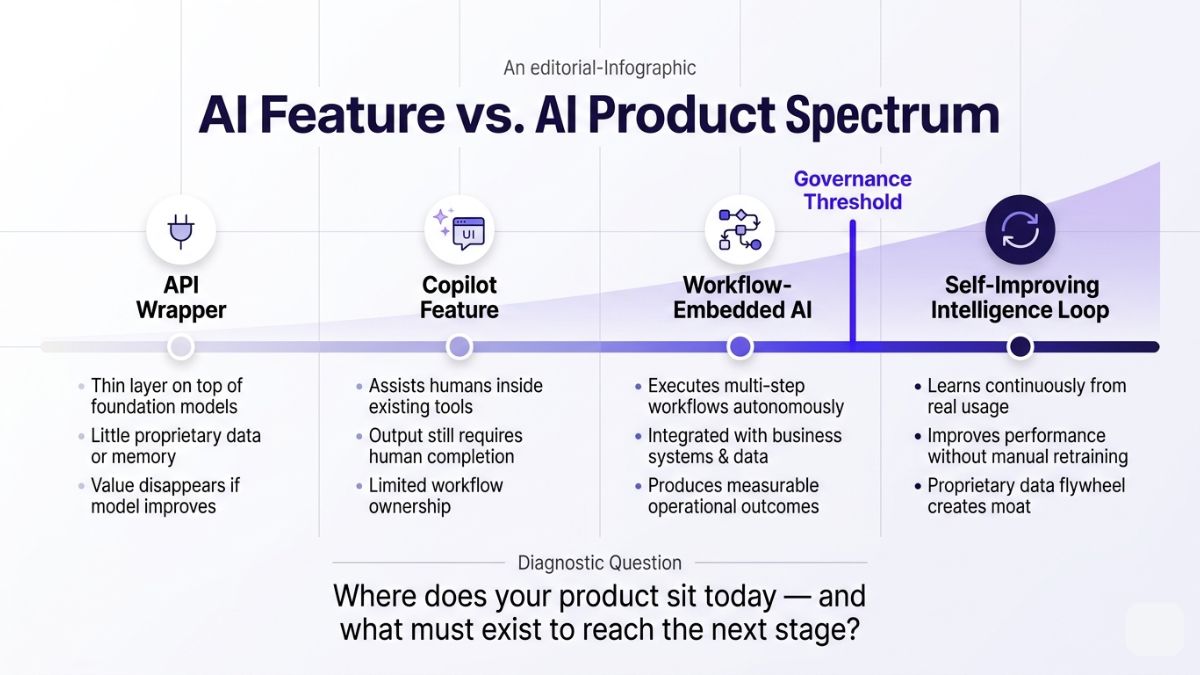
Four positions on a spectrum define where any B2B SaaS product sits architecturally. The positions are diagnostic, not judgmental — knowing where you are is the prerequisite for knowing what the next investment requires.
Stage 1 — API Wrapper
Foundation model plus a custom front end. No structured outcome data captured. The product's AI quality is entirely determined by the underlying model. Fully replicable by any competitor with API access and a few sprints.
Stage 2 — Copilot Feature
AI assists within an existing product workflow. Some interaction data is captured, but it is not labeled outcome data and is not fed back into model improvement. The product may improve as the underlying model improves, but it does not improve from customer usage. Replicable within a sprint by any competitor that prioritizes the feature.
Stage 3 — Workflow-Embedded AI
AI handles execution within defined product workflows. Structured outcome data is captured at some touchpoints. A feedback pipeline is partially instrumented. The product has the beginning of a learning loop, but model improvement requires manual engineering intervention. The gap to replication is measured in months, not sprints.
Stage 4 — Self-Improving Intelligence Loop
The product architecture is designed around data accumulation as its primary function. The model improves automatically from production usage. Users benefit from aggregate learning across the entire customer base — the product gets smarter for every customer when any customer uses it. Switching cost compounds over time. This is the intelligence moat.
At Stage 3 and above, AI governance becomes a design requirement, not a compliance afterthought. In one illustrative case shared by a practitioner: after deploying five or six AI services in production — with prompts updated without version control and APIs swapped without dependency documentation — an enterprise customer requested a full audit trail of which models had touched their data. The team needed two weeks to reconstruct an answer that should have been instantly retrievable. At enterprise scale, that scramble costs the deal. Model versioning, dependency tracking, and audit trails must be built into the architecture at Stage 3, not requested by legal at Stage 4.
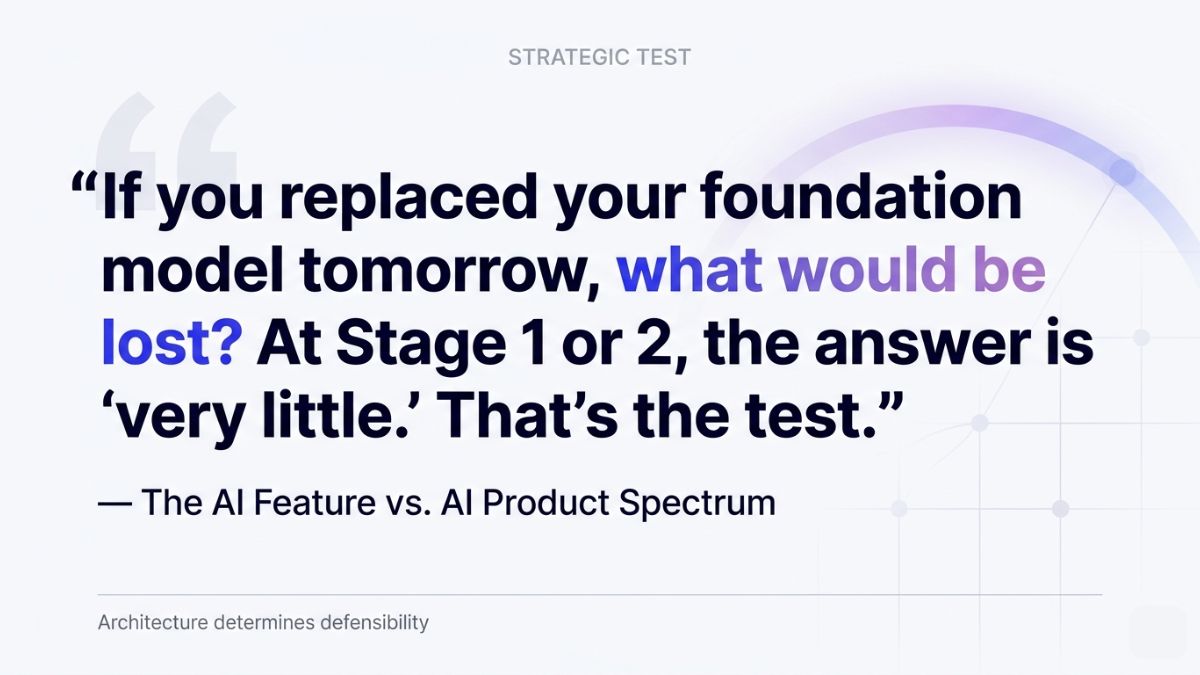
The diagnostic question that locates any product on this spectrum in thirty minutes: if you replaced your foundation model tomorrow, what would be lost?
At Stage 1 or 2, the answer is "very little — the interface stays the same and the new model might actually perform better." At Stage 4, the answer is "the entire accumulated intelligence of our customer base — the training data, the personalized model weights, the outcome labels from every customer interaction." The distance between those two answers is the distance between a feature and a moat.
The Asymmetric Threat: Why AI-Native Startups Don't Need a Better Model to Win
An AI-native startup building in your category today starts with the flywheel designed in from day one, at no additional cost. There is no legacy architecture to retrofit against, no existing data model to redesign, no interaction layer that wasn't built to capture outcome signals. Their flywheel begins compounding from the first customer interaction.
Your retrofit costs engineering cycles, data model redesign, interaction layer changes, and feedback pipeline infrastructure — simultaneously, while your existing product must remain stable and customers must keep receiving value. The competitive threat isn't just AI features; competitors are rebuilding their entire value propositions around intelligence. Feature parity is the wrong response. Shipping an equivalent copilot does not close the architectural gap — it accelerates the race in the wrong direction, consuming engineering resources that should be going toward flywheel infrastructure.
Glean and Gong are the clearest category-level examples of what flywheel-oriented architecture produces at scale. Glean — founded in 2019, built around an Enterprise Knowledge Graph that learns from every search, document acted on, and result accepted — announced $100 million in ARR in February 2025, then grew to an estimated $208 million ARR by end of 2025, at a $7.2 billion valuation. In October 2024, Sam Altman reportedly instructed OpenAI investors to avoid funding five companies, including Glean — a warning widely attributed to competitive concerns about Glean's enterprise data architecture and market position, not simply model performance.
Gong, which captures and labels outcome data from over 4,500 customers' revenue conversations, surpassed $300 million ARR in fiscal year 2025. Neither company built a better version of an existing product. They redesigned their product categories around intelligence accumulation as the core mechanism. The moat in both cases is not model quality — it is proprietary outcome data no competitor can access through an API.
The correct competitive response to AI-native startups is not an accelerated AI feature roadmap. It is architectural investment in data capture infrastructure and feedback pipeline design — starting before the flywheel gap is large enough to become insurmountable.
Three Audit Questions for Your AI Product Roadmap Before the Next Board Meeting
- Does your product collect structured, labeled outcome data from AI interactions — or only interaction logs? If the answer is interaction logs, your data flywheel has no input. The loop cannot close. Everything your AI does is invisible to future model improvement.
- Does your model improve automatically from production usage — or only when your engineering team manually retrains it? If the answer requires an engineering sprint, you are at Stage 2 or early Stage 3. Automatic improvement from usage is the Stage 4 criterion. Everything below it is manual compounding — which is not compounding at all.
- If a competitor built an identical product today with the same foundation model, would they have access to the same intelligence your product has accumulated from your customers? If the answer is yes — the intelligence lives in a model they can access, not in your architecture — your AI strategy is a feature list, not a moat.
Build the Flywheel Now — Why AI SaaS Product Strategy in 2026 Is an Architectural Decision
The copilot feature is not the mistake. The mistake is treating it as an architecture. Shipping AI features on a regular cadence is a product management practice; it is not an AI SaaS product strategy unless those features are building toward the data flywheel and feedback loop that make the product smarter with every interaction.
Zylo's 2026 SaaS Management Index reports that AI-native app spend jumped 108% year-over-year, with large enterprises increasing spend 393%. The market is pricing the intelligence advantage in real time. The companies that will own their categories are not likely to be the ones with the most AI features in 2026 — they are more likely to be the ones who started building the flywheel before the gap was visible.
For teams currently at Stage 2, the sequencing question is the immediate one. The flywheel cannot be built all at once, but it can be started in one place: instrument outcome labeling at the single highest-frequency AI interaction in your product. One feedback loop, one workflow, one labeled signal feeding back into model evaluation. That is not a complete flywheel — but it is the first rotation, and the first rotation is the one that costs the most to retrofit later.
There is a structural connection worth naming: products that compound intelligence tend to also compound capital efficiency. A product that gets smarter from customer data may acquire the next customer at lower cost because it can demonstrate outcomes no competitor can yet match. Flywheel architecture isn't just a product strategy — it's the foundation of compounding unit economics.
The question your board is asking — "do we have an AI strategy?" — is the wrong question. The right question is: does your product get smarter every time a customer uses it? If you can't answer yes without qualification, the architecture work starts now.
Frequently Asked Questions
Q: What is the difference between an AI-native SaaS product and an AI-enhanced product?
A: An AI-enhanced product adds AI as a layer on top of an existing architecture — the product does not improve from customer usage. An AI-native product captures structured outcome data from every interaction and feeds it back into model improvement, so the product gets measurably smarter with use. The difference is architectural, not cosmetic.
Q: What is an AI data flywheel in SaaS?
A: An AI data flywheel is a self-reinforcing loop: customer interactions generate labeled outcome data, which improves the model, which produces better results, which drives more usage, which generates more data. The loop compounds over time. Products that capture structured outcome data — not just interaction logs — can build this flywheel; those that don't cannot.
Q: How do I know if my SaaS product has a real AI strategy or just AI features?
A: Answer this question: if you replaced your foundation model tomorrow, what would be lost? If the answer is "very little," your product is at Stage 1 or 2 — the AI quality lives in the model, not your architecture. If the answer is "our entire accumulated customer intelligence," you have the beginning of a moat.
Q: Why can't I retrofit a data flywheel onto my existing product later?
A: Retrofitting requires redesigning the data model, adding outcome labeling to the interaction layer, and building a training feedback pipeline — simultaneously, while keeping the existing product stable. The engineering cost is prohibitive relative to building it at inception. AI-native startups pay zero for this; established products pay full architectural redesign cost.
Q: What should a Stage 2 SaaS product do first to start building toward a flywheel?
A: Instrument outcome labeling at your single highest-frequency AI interaction. One labeled signal feeding back into model evaluation is not a complete flywheel, but it is the first rotation — and the first rotation is the one that becomes most expensive to retrofit later. Start narrow, instrument deeply, then expand the feedback pipeline from there.