
LinkedIn's Work Change Report found that by 2030, 70% of the skills used in most jobs will change. Their January 2026 Labor Market Report found that nearly 80% of professionals already feel unprepared to find a new one. If you're a CHRO designing through AI job disruption in 2026, adding "AI tool proficiency" to job descriptions isn't a strategy. It's rearranging furniture in a building under demolition.
The private uncertainty CHROs carry into these decisions is real and warranted. Faisal Hoque, a leadership and transformation practitioner who studies enterprise AI adoption, captures what's happening inside most organizations: "Speed without direction is a pressure system, not a strategy — the 'illusion of faster' is burning teams out." The dominant response — update job descriptions, invest in reskilling, wait for the disruption to clarify — is not wrong because it's poorly executed. It's wrong because it targets the wrong structural problem.
AI doesn't add a new tool category to existing roles. It decomposes roles into constituent tasks, automates some, augments others, and leaves a remainder that frequently doesn't cohere into meaningful work. The job description is the artifact of an organizational model that agentic AI is actively dismantling — and organizations updating that artifact while the model dissolves are accumulating organizational debt that will require expensive unraveling within 24 months.
This article introduces the Outcome Profile: a replacement architecture for the job description that defines what a human–AI team delivers, maps human judgment domains against AI task allocation, and makes role coherence visible before the workforce model fails. The argument has four parts: how agentic AI atomizes roles, what fragmentation leaves behind, what Outcome Profiles do instead, and why the planning window is finite.
Agentic AI Doesn't "Augment" Roles — It Atomizes Them
The augmentation narrative reassures boards and calms workforces. It also obscures the architectural shift now producing measurable organizational problems.
Augmentation assumes role stability. The mental model is a human worker with an AI tool attached — the same job, performed faster and more completely. This framing held during the early GenAI era, when AI assistance meant a chatbot drafting emails or a code completion tool speeding up familiar tasks. It does not hold for agentic AI, which executes multi-step workflows autonomously without continuous human direction.
The distinction is operational, not theoretical. Anthropic economists Maxim Massenkoff and Peter McCrory, in their March 5, 2026 paper "Labor Market Impacts of AI: A New Measure and Early Evidence," introduced "observed exposure" — the gap between AI's theoretical capability to perform a task and actual enterprise adoption of that capability. Their finding: actual AI usage in professional settings is far below theoretical capability, the gap is role-specific, and it is currently ignored by most workforce planners. CHROs designing for theoretical potential are solving for a disruption that hasn't fully arrived, while building structures that are already incoherent today.
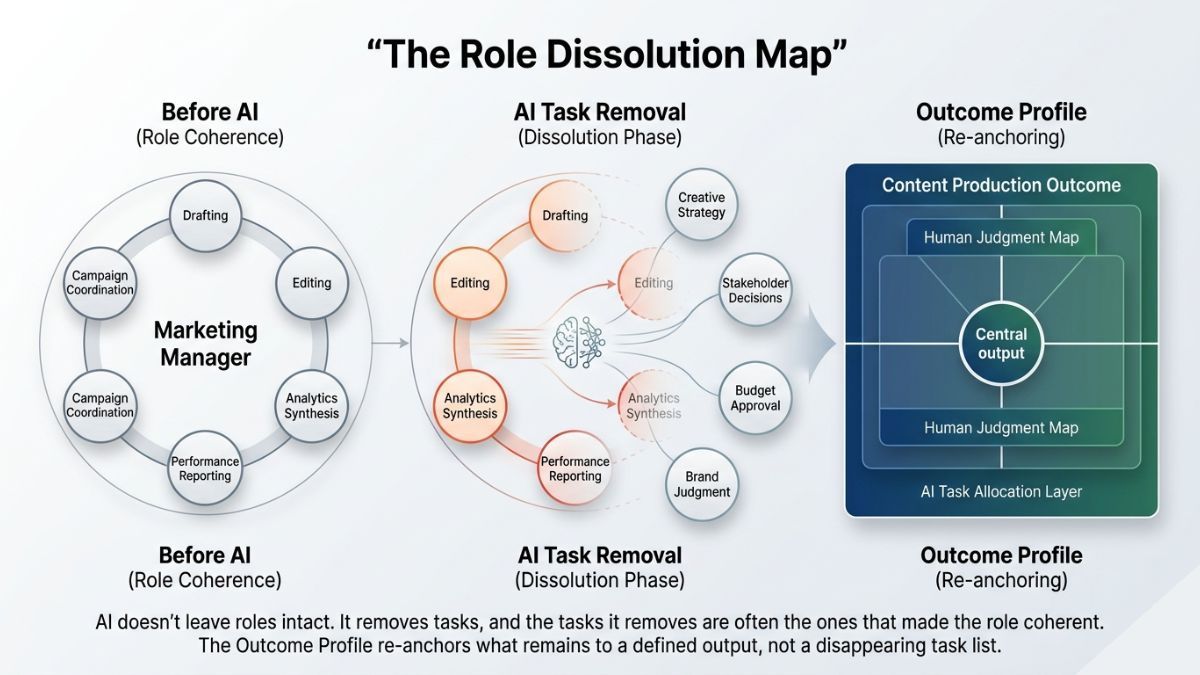
The critical distinction is between tasks and roles. A role is a bundle of tasks organized around a coherent identity and accountability structure. Augmentation tools assist with individual tasks; the bundle stays intact. Agentic AI doesn't assist with tasks — it absorbs them. When an agentic system can research, draft, edit, analyze performance data, and generate strategic recommendations in a single workflow cycle, the task bundle a role was organized around begins to dissolve. G2's August 2025 survey of over 1,000 B2B decision-makers found that 57% of companies already run agentic systems in production — which means content strategist roles, among others, are already experiencing this absorption in practice.

When AI absorbs a majority of the tasks that define a role, the remaining portion doesn't automatically reassemble into a coherent new role. It fragments.
Designing roles around observed, not theoretical, task automation is where most organizations aren't yet looking. March 2026 marks an inflection point for enterprise-scale agentic workflows. The question is not whether AI will augment your workforce. It is what remains of your roles after it does — and whether what remains is work anyone can perform coherently.
The Hybrid Remainder Problem: Fragmented Work After Automation
When AI automates the automatable tasks within a role, the remaining tasks don't form a coherent new job. They form a fragmented residue that is difficult to perform, evaluate, and staff — because it was never designed as a job. It was designed as a byproduct.
This is the Hybrid Remainder Problem: when AI absorbs a significant share of a role's task composition, what remains frequently lacks a coherent identity, a learnable skill trajectory, or a clear accountability structure. The employee isn't elevated — they're stranded. They own the pieces of the job that are hardest to define, most dependent on undocumented context, and least connected to the output metrics the organization actually tracks.
Consequences are already documented. Thomas Davenport and Laks Srinivasan's January 2026 HBR research identified "anticipatory cuts": companies making workforce reductions based on AI's projected future capabilities, not proven current performance. One practitioner-circulated case illustrates the failure mode: a technology firm cut both senior and junior developer headcount based on AI productivity projections. When the remaining workforce was presented with the incoherent task residue — oversight, exception handling, and judgment calls AI hadn't actually absorbed — they resigned en masse rather than accept the workload. The firm rebuilt an entirely new team from scratch, at a cost that exceeded the savings the cuts were designed to generate. Anticipatory cuts produced organizational debt more expensive than the disruption they aimed to manage.
Training is the dominant answer offered. It is also the wrong answer — worth saying directly, because the reskilling industry's value proposition depends on it being true. Training teaches people to use AI tools. It does not create coherent roles from incoherent task fragments. If AI has automated first-draft writing, accelerated editing, and synthesized analytics within a content strategist's role, no amount of prompt-engineering training reassembles those remnants into meaningful work. Reskilling solves a skill gap. The Hybrid Remainder Problem is a design gap.
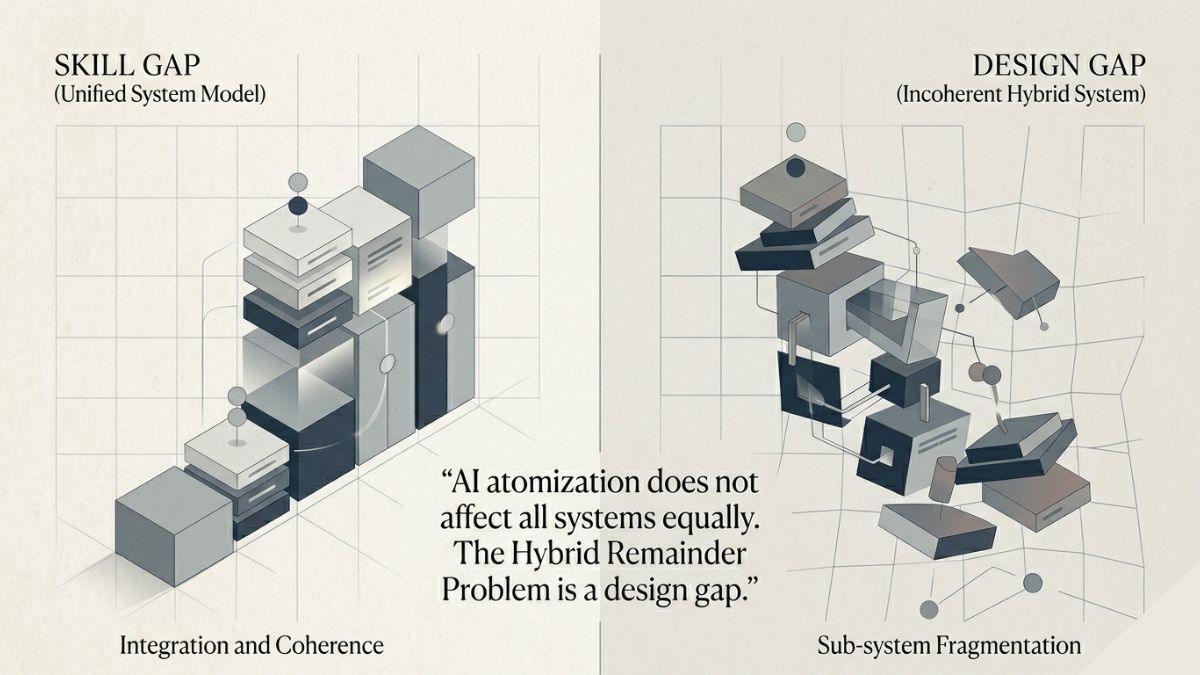
The MIT NANDA study — The GenAI Divide: State of AI in Business 2025, published July 2025, based on 300+ publicly disclosed AI initiatives, 52 organizational interviews, and 153 senior leader surveys — found that 95% of enterprise AI pilots produced zero measurable P&L impact. Many pilots didn't fail because the technology underperformed. They failed because organizations had no mechanism for converting AI task absorption into coherent role redesign.
For each of the three most common roles in your organization: which specific tasks are fully automatable today, which require irreplaceable human judgment, and what remains constitute a coherent job — or a fragmented one? If that third question is uncertain, the Hybrid Remainder Problem is already present. The question is only whether it's visible yet.
Outcome Profiles: The Replacement Architecture for Job Descriptions
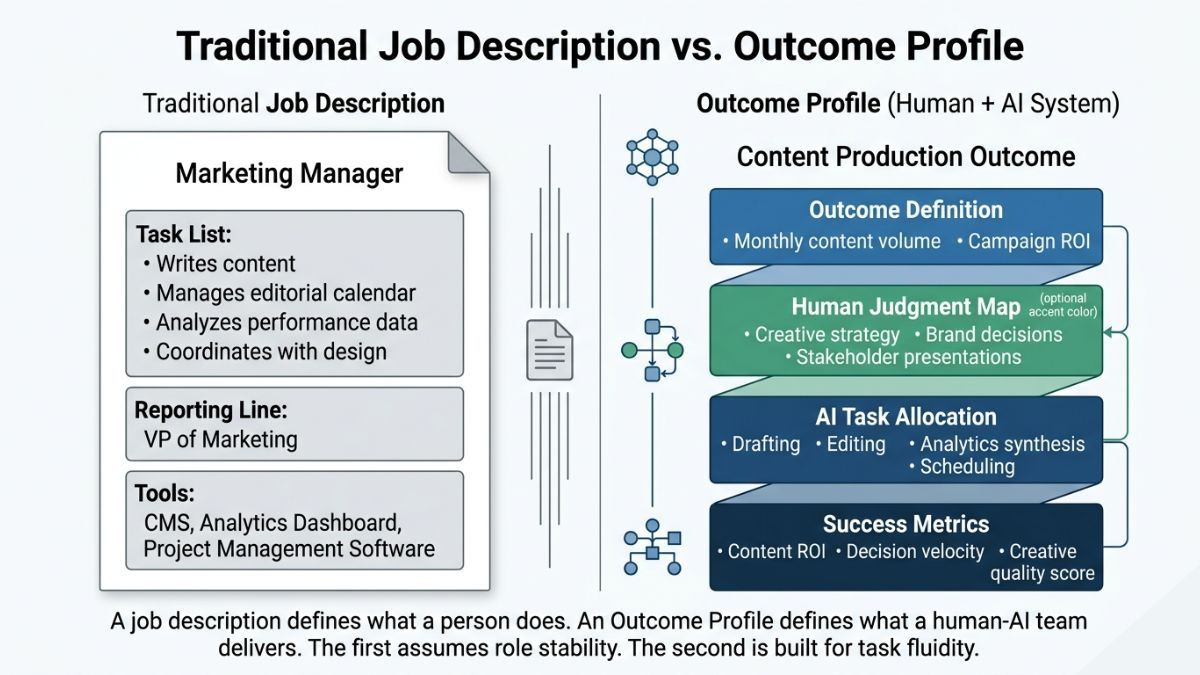
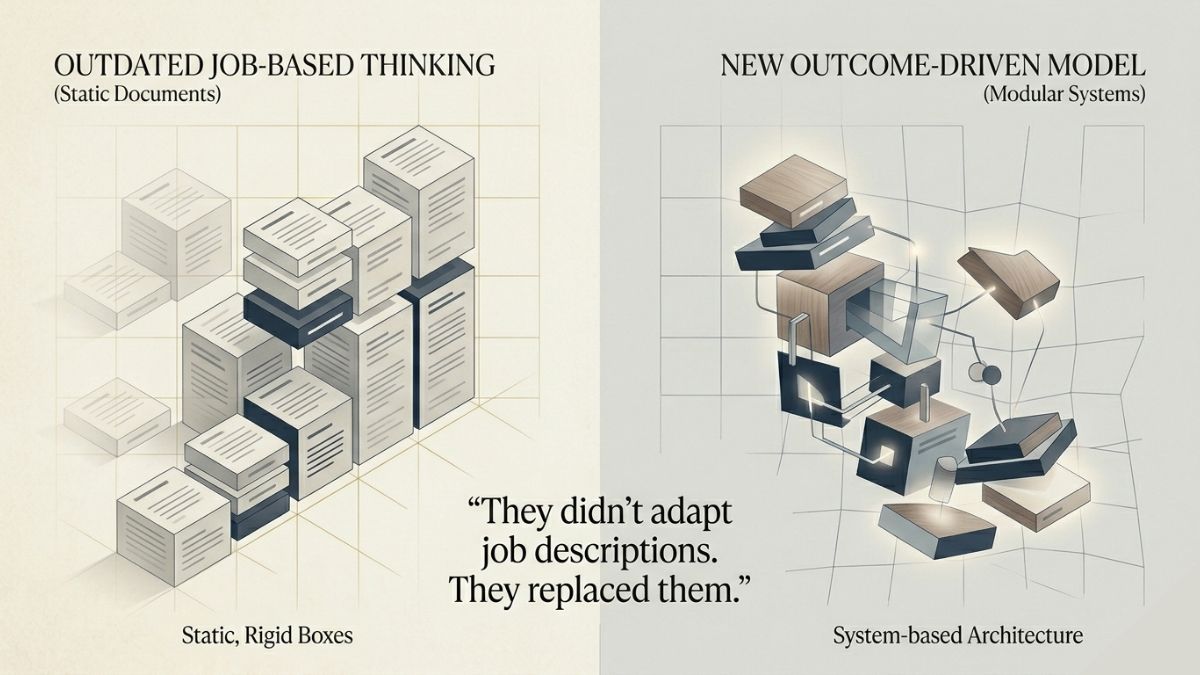
The job description is a product of industrial-era design: a static artifact defining what an individual does, their reporting lines, tool requirements, and task lists. It functions when task bundles are stable and human-only. In environments where AI continuously absorbs tasks from those bundles, the job description becomes a planning instrument built on disappearing foundations.
An Outcome Profile defines what a human–AI team delivers — not what an individual does. It has four components.
- Outcome Definition: the measurable result the team is accountable for producing. Not "responsibilities" — a defined output: content volume and campaign ROI for a content production team; claims-processing throughput and error rate for operations; code shipping velocity and security-incident rate for engineering. The outcome stays stable even as task allocation shifts.
- Human Judgment Map: the tasks within scope that require human judgment — novel problems, stakeholder decisions with political or reputational stakes, ethical calls requiring contextual accountability, and situations where AI confidence is insufficient for autonomous action. This is not a list of "things humans do." It specifies where human judgment is irreplaceable — a smaller category than most assume.
- AI Task Allocation: a current-state map of which tasks are fully automatable now, which are AI-augmented with human verification, and which remain human-directed with AI support. It is revisited on a defined schedule as capabilities and adoption evolve.
- Success Metrics: team-level outcome measurements, not individual task completion rates. The job-description metric structure becomes incoherent when some responsibilities are AI-performed and others are human. Outcome Profiles measure what the human–AI team produces together.
Direct evidence of what this produces comes from a cloud security engineering organization that integrated AI for routine and supervised tasks and explicitly preserved human roles for the judgment layer. One engineer described the change: "It's taking all the tedious tasks I used to have and allowing me to focus on novel problems I never had time for. In fact, while my organization leans heavy into AI, we're also adding humans faster than we ever have." They didn't arrive there by updating job descriptions. They applied Outcome Profile logic — AI handling the automatable layer, humans elevated to the judgment layer — which produced role coherence and headcount growth rather than the fragmentation and displacement that anticipatory-cut organizations experienced.
What is an Outcome Profile?
An Outcome Profile replaces the job description by defining a team's measurable outcome, mapping where human judgment is irreplaceable, allocating tasks between AI and humans based on current capability, and tying performance to team-level success metrics. It keeps roles coherent as AI absorption changes task composition.
From Traditional Role to Outcome Profile
Traditional role (before): "Marketing Manager" — task list: brief writers; draft copy; edit; analyze performance; coordinate designers; report to VP Marketing. Metrics: individual responsibilities checked off; sporadic campaign KPIs.
Outcome Profile (after): Outcome: "Content Production and Performance" — X assets/week; Y% campaign ROI; CAC within target. Human Judgment Map: brand voice arbitration; risk and PR calls; stakeholder prioritization; novel campaign strategy. AI Task Allocation: ideation at scale; first-draft generation; variant testing; performance analysis; distribution scheduling — with human verification gates on brand, claims, and compliance. Success Metrics: output volume, ROI delta vs. baseline, time-to-publish, error rate, lift from variant testing.
CHROs can sketch this in one working session: list current tasks; tag each as automate, augment, or judgment; define the outcome; assign verification gates; set metrics; calendar a 90-day review.
Why Training Alone Can't Solve AI Workforce Transformation
The reskilling industry markets training as the lever for AI workforce transformation. Training is necessary — people must learn to supervise agents, set guardrails, and make better judgment calls with AI-generated evidence. But training can't solve an architectural problem. If a role's task bundle has been atomized by agentic AI, adding skills to the person inside that bundle doesn't restore coherence. The bundle must be redesigned around an outcome, with tasks reassigned between AI and humans.
Upskill into a structure — don't upskill to compensate for the absence of one.
The Organizational Debt Timeline: Your 18-Month Competitive Window
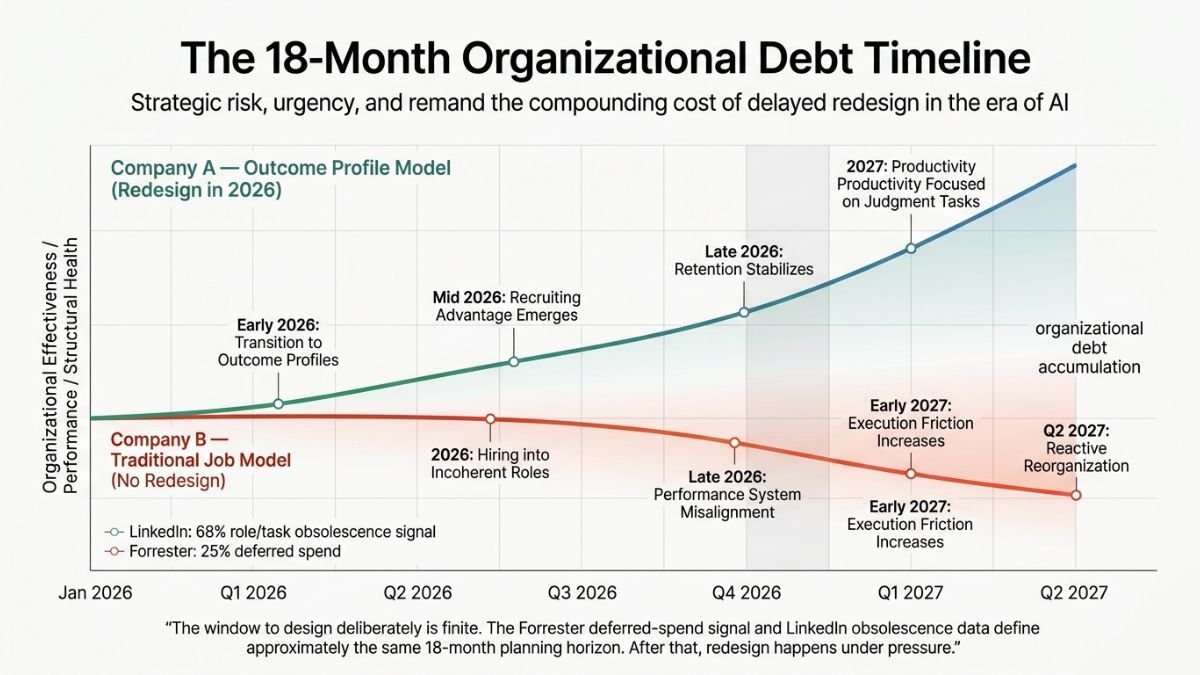
The gap between AI's theoretical capability and observed enterprise adoption is not a comfort zone. It's a finite planning window.
Forrester's 2026 Technology and Security Predictions projects that 25% of planned 2026 AI spend will be deferred to 2027 as financial scrutiny slows production deployments. That deferral is the window during which organizations can design deliberately, before market pressure compresses the timeline into crisis response.
The Massenkoff–McCrory "observed exposure" finding is the strategic signal: AI capability measurably exceeds enterprise adoption across every occupational category studied. That margin is where organizational design operates. It will close.
Compounding advantage is already visible. Since 2022, PwC's 2025 Global AI Jobs Barometer reports that productivity growth has nearly quadrupled in industries most exposed to AI — rising from 7% (2018–2022) to 27% (2018–2024) — with the most AI-exposed industries now seeing 3x higher revenue per employee growth than the least exposed. That gap widens every quarter organizations delay structural redesign.
What this means in financial terms:
- Company A (Outcome Profiles in 2026): coherent recruiting pitch ("own the judgment layer"); lower resignation risk from incoherent remainders; faster time-to-productivity as agents shoulder routine tasks; cleaner P&L attribution to outcome-level metrics.
- Company B (job-based through 2026): hidden liabilities accumulate — hires into vanishing roles, performance reviews against obsolete descriptions, promotions into roles with collapsing task bundles. 2027–2028 becomes an expensive unwind: severance, retention packages, rehire premiums, productivity troughs — erasing any savings from anticipatory cuts.
In recruiting, Outcome Profiles produce roles with coherent value propositions — candidates can decide whether they want to own a judgment layer in a human–AI team. In retention, the mass-resignation case above wasn't driven by displacement fear; it was the experience of being handed incoherent fragments. In productivity, human effort aimed at judgment tasks where it is irreplaceable produces different returns than effort spent on tasks AI can perform — regardless of whether it currently does.
Companies maintaining job-based models through 2026 don't avoid this reckoning. They defer it — and organizational debt compounds in the interim.
Every hire into a structurally incoherent role is a liability. Every performance review against an obsolete job description is an accountability system that cannot function. Every promotion into a vanishing role is a retention risk and a succession-planning failure waiting to surface.
The planning question is whether the window closes into a workforce structure someone designed — or one that assembled itself from the fragments left behind.
How to Start This Quarter: A Three-Question Diagnostic
No consulting engagement or multi-quarter initiative is required to begin. Convene three functional heads and run this diagnostic against your top three roles:
- Which tasks are fully automatable by the AI tools already deployed?
- Which tasks require human judgment on genuinely novel problems — where defining the decision parameters is the decision?
- Does the remainder constitute coherent work with a learnable skill trajectory and an accountable outcome — or a fragmented residue?
Your outputs drive one of three structural responses:
- Maintain with augmentation: the role is coherent; AI assists without fragmenting its task core.
- Redesign as an Outcome Profile: AI has absorbed enough of the bundle that coherence requires reconstructing around a defined outcome.
- Retire: human judgment is no longer the primary value-generating activity; replace the role with an outcome-based team model.
If you discover you've never performed task-level role analysis, that capability gap is itself the finding that justifies Outcome Profile investment.
Guardrails and Edge Cases CHROs Should Anticipate
- Compliance-sensitive processes: keep human sign-off gates where regulatory exposure or reputational risk is high; document thresholds for agent autonomy and escalation paths.
- Data quality variance: agent performance degrades with noisy inputs; Outcome Profiles should specify data provenance and validation routines before automation expands.
- Change fatigue: redesign cadence matters. Set a 90-day review cycle for AI Task Allocation; avoid weekly churn that destabilizes teams.
- Vendor lock-in risk: map AI tasks to outcomes, not to specific tools; this keeps the design portable as capabilities evolve.
- Measurement integrity: align Success Metrics to finance-accepted definitions (e.g., ROI calculation methods) to prevent attribution disputes and ensure P&L relevance.
Conclusion: Architecture, Not Accessories
The three arguments here form a chain, not a list. Agentic AI atomizes roles because it operates at the task level — it absorbs task bundles rather than augmenting the roles they once defined. Task atomization produces the Hybrid Remainder Problem when organizations have no mechanism for reconstructing coherent work from what AI hasn't yet absorbed. And the Hybrid Remainder Problem cannot be solved by training people to use AI tools better, because the problem is organizational design, not the skill set inside it.
What this means for the CHRO's immediate work is architectural, not operational. The conversation to have with the CEO is not "how do we accelerate AI adoption" or "how do we manage workforce transition." It is: "which of our roles are already fragmented, which are heading there, and what is the replacement structure that makes human work coherent on the other side?" That is an organizational design question — which is what Outcome Profiles provide and job descriptions cannot.
The urgency is not manufactured. Davenport and Srinivasan's HBR research documents that companies making reactive workforce decisions are paying more to recover than they saved by acting early. CHROs who arrive at Q4 2026 board conversations with Outcome Profile frameworks and task-level role analyses will be having a different strategic conversation than those arriving with updated job descriptions. Both will be talking about AI job disruption in 2026. Only one will be talking about architecture.
Download the Outcome Profile Template to begin the redesign conversation with your leadership team this quarter.
The organizations that will lead through AI disruption aren't the ones that adapted job descriptions fastest — they're the ones that replaced them first.