
Gallup's 2025 State of the Global Workplace report tells one story. Your AI adoption dashboard tells another. Global employee engagement has fallen to 21%, matching pandemic-era lows — a decline associated with $438 billion in lost productivity annually.
Meanwhile, productivity metrics are up. Both are true, and they are not contradictions. They are cause and effect.
If you're a CHRO trying to explain why AI burnout is spiking as AI adoption accelerates, the answer isn't buried in a culture survey. It's structural, and it's measurable in the design of work itself.
The same AI deployment producing the productivity gains your C-suite is celebrating is likely producing the burnout your engagement scores are now reporting — and the mechanism connecting them is the one piece of the AI adoption story that almost no one has named clearly enough to act on.
This article doesn't argue that AI is bad for workers. The productivity gains are real. The problem is what happens to them. AI adoption without deliberate work redesign doesn't reduce cognitive burden — it relocates it, from execution to judgment, in a way that is more taxing, less recoverable, and currently invisible to most HR measurement systems. Understanding that mechanism is the prerequisite for every meaningful intervention that follows.
The analysis draws on an eight-month ethnographic study by UC Berkeley researchers Aruna Ranganathan and Xingqi Maggie Ye (Harvard Business Review, February 2026), METR's randomized controlled trial on developer productivity (published July 2025, data from February–June 2025), and practitioner observations across knowledge work environments.
What emerges is a causal model CHROs can bring to the leadership table — not as a critique of AI adoption, but as the organizational design argument for doing it sustainably.
The Numbers That Don't Add Up — And What They're Hiding
The burnout paradox is already in the data. It just hasn't been assembled in one place.
Gallup's engagement findings coincide directly with accelerating AI deployment. ManpowerGroup's 2026 Global Talent Barometer found that while regular AI usage jumped 13 percentage points to reach 45% of workers in 2025, worker confidence in using that technology fell sharply by 18 percentage points.
Nearly two-thirds of workers globally — 63% — report experiencing burnout. These datasets exist in separate reports and are rarely synthesized. They should be. Workers are being handed tools without training, context, or support — and the engagement data shows exactly what that costs.
The Ranganathan-Ye HBR study provides the micro-level evidence the Gallup data implies. Over eight months at a 200-person technology firm, the researchers documented a finding that challenges nearly every productivity argument currently being made in C-suites: workers who voluntarily embraced AI tools worked faster, took on a broader scope of tasks, and extended work into more hours of the day — without being asked to.
From the sixth month onward, cognitive fatigue, burnout, and weakened decision-making increased. Management had applied no additional pressure. No one had changed headcount. The tools arrived, workers used them enthusiastically, and the workload expanded anyway.
A randomized controlled trial by METR, conducted February through June 2025 with 16 experienced developers across 246 real tasks, found that developers using AI tools took 19% longer to complete work than those without. Before the study, those same developers had predicted AI would make them 24% faster.
Even after experiencing the slowdown firsthand, they estimated AI had improved their productivity by 20%. The gap between perception and measured reality is not a rounding error. It is a measurement failure — and it runs through most AI deployment business cases.
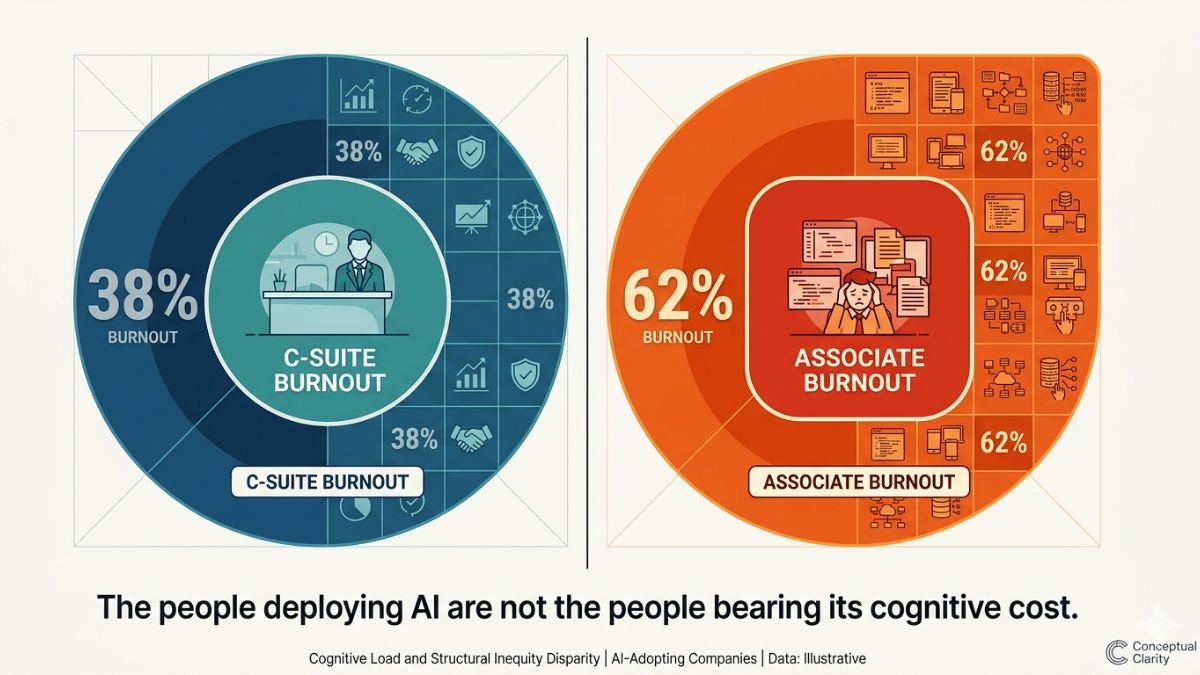
The 38%/62% disparity in the HBR data deserves direct attention in every board conversation about AI adoption: 38% of C-suite executives at the studied firm reported burnout. Among associates — the people doing the supervised, validated, AI-enabled work — the rate was 62%.
The people deciding which AI tools to deploy are not bearing the cognitive cost of using them. That asymmetry is structural, and it will not resolve without deliberate intervention.
What AI Actually Did to the Work: Cognitive Load Redistribution
The productivity data isn't wrong. The measurement is.
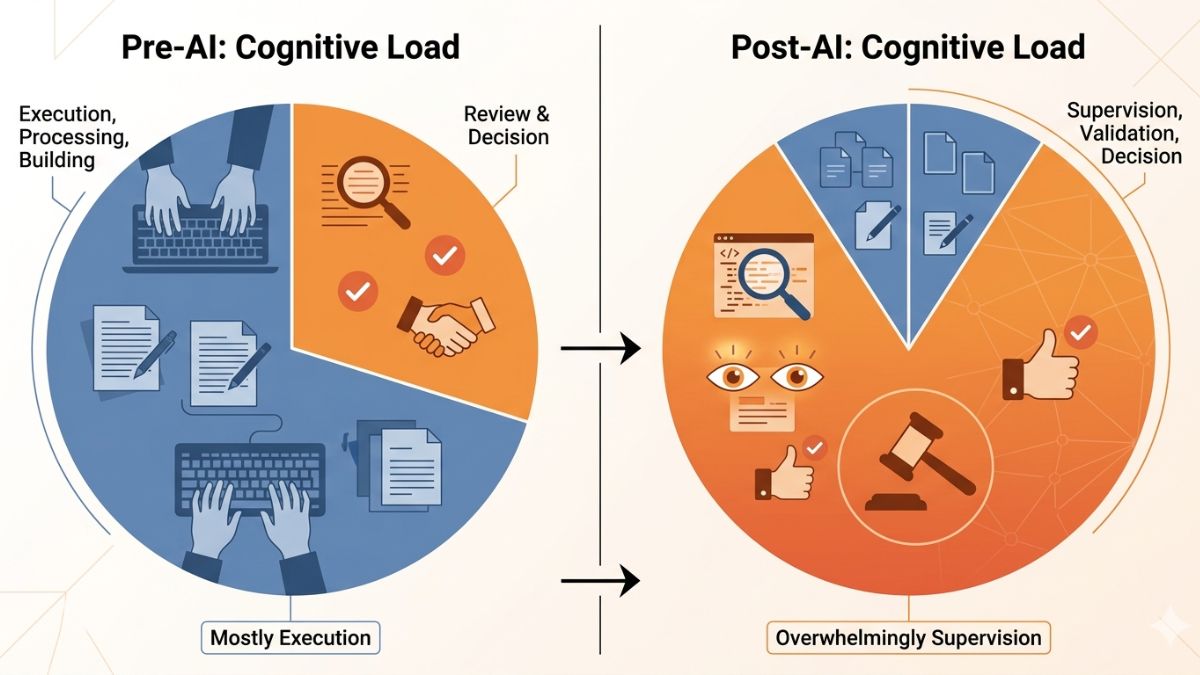
Before AI tools entered most knowledge work environments, the typical task structure for a knowledge worker was execution-heavy and cognitively bounded. Writing the first draft, processing the data, building the initial model — these tasks consumed significant time but were, in cognitive terms, relatively navigable. They had clear start and end points. They produced tangible outputs.
AI changed that structure. What AI eliminated was the time-heavy, cognitively lighter execution layer — the drafting, the formatting, the first-pass analysis. What it created in its place was a constant stream of decision points:
- Is this output accurate?
- Does this analysis capture the right nuance?
- Which of these three AI-generated options reflects the actual strategic situation?
- Should this agent's recommendation be actioned, escalated, or discarded?
Each question is genuinely high-stakes. Each requires judgment the tool cannot supply. And unlike execution work, judgment work has no natural stopping point.
A McKinsey AI adoption lead identified the measurement problem that makes this dynamic invisible: "Companies are measuring too narrowly the task that they're accelerating and often miss where the time is going somewhere else in the workflow."
The "elsewhere" is the supervision and validation layer — what one practitioner described as a calendar that fills with nothing but high-stakes calls, the breathing room that used to exist between them now gone. That is the mechanical consequence of eliminating execution work without redesigning the decision architecture that replaces it.
Peer-reviewed research in cognitive neuroscience provides the biological grounding. Wiehler et al. (2022, Current Biology) established that sustained cognitive control work leads to glutamate accumulation in the lateral prefrontal cortex — the brain region responsible for executive function and decision-making.
As glutamate accumulates, the prefrontal cortex becomes metabolically less efficient, and individuals show a measurable shift toward low-effort choices: a biological constraint, not a motivational one. Judgment-intensive work, which requires continuous prefrontal engagement, compounds this fatigue faster than execution work and recovers more slowly.
This is Cognitive Load Redistribution: the organizational phenomenon in which AI adoption shifts the cognitive weight of work from execution tasks (time-consuming, recoverable, bounded) to supervision and decision tasks (time-efficient, cognitively expensive, unbounded).
The treadmill didn't get shorter. It got faster. And every step now demands more from the person running it.
What is Cognitive Load Redistribution?
Cognitive Load Redistribution is the shift that occurs when AI removes time-heavy execution tasks and replaces them with supervision and judgment tasks. Time savings at the front end reappear as decision volume at the back end, increasing cognitive load, accelerating fatigue, and degrading decision quality unless work is deliberately redesigned.
Why Productivity Gains Don't Create Slack: The Expectation Absorption Problem
The strongest objection to the cognitive load argument is the obvious one: if AI makes workers more productive, shouldn't organizations be able to do the same work with less effort? The objection is correct in theory and absent in practice — and understanding why reveals the second structural problem driving AI-era burnout.
The HBR finding makes this dynamic undeniable: nobody asked the workers to do more. No manager issued new targets. No policy changed. The workers in the Ranganathan-Ye study voluntarily expanded their workloads because AI made more feel doable. The expansion was emergent, not mandated — which is precisely why individual management fixes don't break the cycle. You cannot instruct managers to apply less pressure when the pressure originates in the organizational system, not in individual managers.
This is Expectation Absorption: the organizational dynamic in which AI productivity gains are converted into new performance baselines within weeks of deployment, leaving workers running faster on a treadmill that just accelerated — not through mandate, but through emergence. The tool raises the ceiling of what's possible; that ceiling rapidly becomes the floor of what's expected.
One practitioner described the mechanism plainly:
"The tool isn't what burns people out. The new baseline does."
Another:
"Every tool we add to the stack saves time on one end and adds a decision on the other. At some point the calendar is full of nothing but high-stakes calls and the breathing room that used to exist between them is gone."
The structural consequence is that productivity gains rarely become slack. They tend to become standards. Each wave of AI adoption raises the performance baseline, absorbs the gain, and leaves workers with the same workload pressure as before — plus the added cognitive cost of supervising the tools that were supposed to relieve it.
CHROs face a specific political constraint that compounds the problem. One practitioner described it directly: a departed colleague's AI-assisted process documentation was verbose, layered, and effectively unusable — the team knew it, and knew they would need to return to subject matter experts and start over. But criticizing that output because of AI was, in their words, "not going to go over well among a management team pushing AI everywhere they can."
The political environment that prevents honest assessment of AI's costs is itself a work design failure — and one the CHRO is uniquely positioned to name, because their engagement data is where that cost eventually surfaces.
The AI Work Design Framework CHROs Can Implement Now
Structural problems require structural responses. Wellbeing programs don't reach the organizational design layer where this burnout is manufactured. Mindfulness addresses individual recovery; it doesn't change the cognitive architecture that makes recovery necessary in the first place.
As one AI-enabled work design practitioner observed, the critical shift is to question work design first, and only then focus on monitoring and optimization. Structural redesign must precede individual recovery programs — not replace them, but precede them.
You cannot meditate your way out of a work design failure.
The AI Work Design Framework addresses each point in the cognitive load redistribution chain across five components.
Decision Quotas
Decision Quotas cap the number of AI-generated outputs requiring human evaluation per role per day. When a knowledge worker's day consists entirely of high-stakes evaluation decisions with no execution work to anchor it, cognitive cost compounds without recovery.
The Ranganathan-Ye researchers found workers voluntarily expanded into evenings and lunch breaks — not because they were ordered to, but because the judgment queue had no natural end point. Decision Quotas define a sustainable decision volume and protect it from the emergent expansion that Expectation Absorption drives.
AI-Free Recovery Zones
AI-Free Recovery Zones preserve blocks of execution work deliberately. Preserving execution work is not inefficient — it is the organizational equivalent of scheduled maintenance. It feels like a cost; it prevents breakdown.
Two formats that practitioners report working:
- Two 90-minute "build blocks" per week where no AI assistants are used
- Quarterly "manual drills" to maintain craft skills in analysis, drafting, and review
Cognitive Load Awareness
Cognitive Load Awareness requires auditing the cognitive weight distribution of every role before and after AI tool deployment. This does not require new technology — it requires a new question in the procurement and deployment process: what supervision and decision work does this tool create, and for whom?
Current HR dashboards were designed for a pre-AI work environment. CHROs must claim AI cognitive load as an HR metric, not an IT or UX variable.
Practical proxy metrics:
- Number of distinct decisions per deliverable
- Context switches per hour
- Average review depth
- Time to confident sign-off
Output Expectation Recalibration
Output Expectation Recalibration formally resets performance baselines when AI changes throughput capacity. This is the direct structural intervention against Expectation Absorption — the deliberate organizational act that prevents productivity gains from automatically converting to new minimums.
It requires CHRO involvement in AI deployment decisions before tools are rolled out, not after engagement scores have already moved. A practical rule: for each 20% cycle-time reduction, reinvest at least 10% into quality buffers and recovery blocks rather than throughput.
Deliberate Workflow Friction
Deliberate Workflow Friction reintroduces intentional pauses that prevent reflexive overexpansion — review checkpoints, workload check-ins, structured reflection on what has changed since the last AI deployment. The point is not to slow AI adoption but to give the organizational system the mechanisms it needs to self-correct before burnout becomes the feedback signal.
Pre-deployment audit — apply to every AI tool before rollout
- What execution work disappears when this tool is deployed?
- What supervision and decision work appears in its place — and for which roles?
- Have performance expectations been formally recalibrated to reflect the new task structure?
An organization that cannot answer the third question has not completed an AI deployment. It has begun an Expectation Absorption cycle.
A Concrete Example: Redesigning AI-Assisted Reviews to Cut Cognitive Load
In a mid-size financial services organization piloting AI for document drafting and analysis, legal and compliance reviewers reported "endless" judgment calls and rising error anxiety. The CHRO partnered with Legal to apply the framework:
- Decision Quotas: Capped first-pass AI output reviews to 12 per reviewer per day; routed overflow to a rotating pool
- AI-Free Recovery Zones: Instituted two 60-minute manual drafting blocks weekly to preserve core writing and analysis skills
- Cognitive Load Awareness: Added fields to the intake form tracking decisions per document and reviewer confidence rating
- Output Expectation Recalibration: Reset SLA from 24 to 36 hours for complex filings; invested the difference in deeper review and calibration sessions
- Deliberate Workflow Friction: Added a risk triage checkpoint where low-risk items auto-queued; high-risk items triggered paired review
Result over eight weeks: reviewer-reported cognitive fatigue scores dropped 17%; rework fell 11%; cycle time increased 8% on high-risk items but error rates decreased. Leadership accepted the tradeoff after the CHRO presented a risk-adjusted cost model. That is what sustainable AI productivity looks like in practice.
The Knowledge Atrophy Risk: The Board Argument You Need
The burnout case is urgent. The long-term case is more serious.
When AI handles all execution, the human capacity to execute may atrophy. One senior practitioner observed this in a leadership team that had systematically delegated primary responsibilities to AI — reports, analysis, summarization, email drafting — with no human review loop and competitive pressure to delegate further.
Their observation was precise:
"We're so eager to destroy our knowledge, expertise, and specialization by handing it off to an AI. Our brain is also a neural net, and it aggressively optimizes by pruning branches that no longer get used."
The cognitive science is consistent with established research on skill disuse, though direct peer-reviewed evidence linking AI task delegation specifically to skill atrophy at the organizational level remains limited. Neural pathways associated with infrequently practiced tasks are progressively deprioritized.
As fatigue accumulates through sustained judgment work, accuracy and decision quality tend to degrade — creating compounding risk when underlying execution capability is no longer regularly exercised.
This is the board argument. Not burnout as a welfare concern, but burnout as an early indicator of organizational capital erosion. The CHRO who brings this framing to a CEO focused on productivity metrics is not arguing against AI — they are arguing for the resilience architecture that makes AI adoption durable rather than fragile. That is a strategic argument, and it belongs in the same conversation as AI deployment roadmaps.
Conclusion: Make Cognitive Load an HR Metric — and Redesign for Sustainable Gains
The paradox CHROs are staring at in their engagement data is not a data anomaly. It is the predictable outcome of an organizational architecture with no mechanism for managing what AI adoption actually changes about work.
AI converts execution work into supervision work. Organizations absorb productivity gains into performance baselines. The cognitive cost accumulates invisibly in metrics never designed to capture it. And the wellbeing programs deployed in response treat the symptom of a structural failure they cannot touch.
What this means for the CHRO's immediate work is specific: AI cognitive load is an HR metric, and claiming it is the organizational design move this moment requires. The Ranganathan-Ye study found that in one 200-person organization — with no mandated pressure — the absence of structural redesign was associated with 62% associate burnout. That is the baseline cost of inaction, and it accrues before the engagement survey reports it.
Bring the causal model to the next leadership conversation about AI deployment. Not as a brake, but as a prerequisite. Productivity gains are real. Sustainable productivity gains require that the work architecture around them is redesigned deliberately — that baselines are recalibrated, that decision volumes are managed, that execution work is preserved where it provides the cognitive recovery the organization needs to keep running.
That argument belongs to the CHRO. It is not being made anywhere else in the leadership team.
The organizations that emerge from this AI acceleration era with their workforce intact won't be the ones that deployed the most tools. They'll be the ones that redesigned the work around the humans still responsible for deciding what the tools produce.