
In February 2024, Klarna's AI assistant — built with OpenAI — handled 2.3 million customer service conversations in its first month of global deployment, covering two-thirds of all customer service chats.
Customer satisfaction scores matched human-agent benchmarks, repeat inquiries dropped 25%, and resolution time fell from 11 minutes to under 2. Klarna projected $40 million in profit improvement for the year.
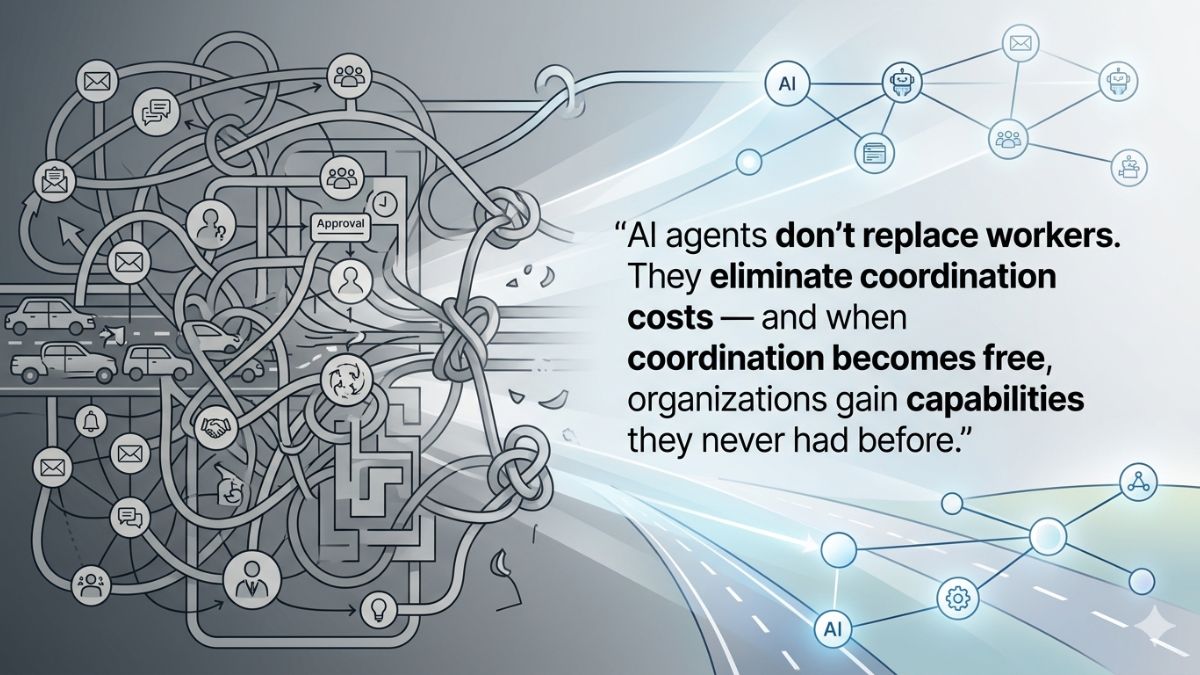
Most headlines called it a jobs story. It wasn't. It was a coordination cost story — and until your organization understands the difference, every agent deployment you approve is solving the wrong problem.
The distinction matters because the strategic question is fundamentally different. Job replacement asks: which roles can we automate? Coordination cost elimination asks: which organizational capabilities become possible when coordination becomes free?
The first question produces efficiency gains. The second produces structural transformation.
We're at an inflection point. McKinsey's 2025 State of AI survey — drawn from 1,993 participants across industries — found that organizations using generative AI rose from 71% in 2024 to 79% by mid-2025.
Gartner projects that enterprise applications with embedded task-specific AI agents will grow from under 5% in 2025 to 40% by the end of 2026. Governance is chasing deployment, not anticipating it.
Boards are asking what the org chart looks like when agents run procurement, compliance reporting, or supply chain coordination. Most CIOs have frameworks for task automation. They don't have frameworks for workflow replacement — and the prototype-to-production gap is widening as a result.
This article introduces the Workflow Replacement Model as a diagnostic for identifying which workflows to automate, defines AgentOps as the emerging operational discipline for managing autonomous systems at scale, and provides the governance architecture — the Pilot of the Autopilot — that gives technology leaders sovereign control over agent systems.
Why the AI Agent Economy Demands a New Strategic Frame
The dominant narrative treats AI agents as sophisticated automation tools that make existing processes more efficient. This framing is inadequate in three specific ways.
First, it produces the wrong deployment question. Job-centric analysis asks which individual tasks can be automated and which workers will be affected. But agents don't automate individual tasks within existing coordination structures — they eliminate the coordination structure itself.
When Klarna deployed its AI system, it didn't replace 700 workers performing identical tasks. It replaced the entire workflow those workers coordinated: ticket routing, knowledge retrieval, escalation paths, quality assurance, shift handoffs, and supervisor oversight.
The workflow disappeared. The coordination cost went to zero.
This is Ronald Coase's transaction cost theory playing out in real time. In his 1937 paper "The Nature of the Firm," Coase argued that organizations exist because market coordination — the cost of discovering prices, negotiating contracts, and managing external transactions — is more expensive than coordinating the same activity internally.
When AI agents eliminate internal coordination costs, the economic logic that determines how much to internalize shifts entirely. Workflows that were previously impossible because coordination overhead made them prohibitively expensive become viable. New organizational capabilities — not just faster existing ones — emerge on the other side.
Second, the efficiency frame has a measurable cost. CIOs who frame agents as efficiency tools build the wrong deployment infrastructure. They approve single-agent pilots scoped to narrow tasks, expect productivity ROI within 90 days, and watch those pilots fail to exit the test environment.
Enterprise practitioners report a consistent pattern: meaningful ROI requires approximately 20 agents working in coordination to transform a job function. One fintech deployment lead who spent three months building agent systems across banking clients put it directly:
"To transform a job that generates ROI, an average of 20 agents need to work together or separately."
(Practitioner benchmark based on three months of banking and fintech deployments.)
The 20-agent threshold isn't arbitrary. Enterprise workflows span multiple departments, involve complex decision trees, and require coordinated handoffs.
A procurement workflow touches requisition creation, vendor selection, price negotiation, compliance verification, approval routing, contract generation, and payment processing. Automating one step produces marginal efficiency. Automating the workflow produces structural capability — procurement operations that were economically impossible at small scale become viable because coordination cost disappeared.
Third, coordination costs are the actual target, not labor costs. When agents eliminate coordination overhead, organizations gain capabilities they never had before.
A compliance reporting workflow that previously required three departments, two weeks, and 17 approval handoffs can now run continuously with autonomous verification and real-time documentation. The organization didn't get faster compliance reporting. It got compliance monitoring at a frequency and granularity that was previously impossible.
That's a new capability, not an efficiency gain.
Understanding what agents actually replace requires a new diagnostic model.
The Workflow Replacement Model: Diagnosing Which Workflows to Automate First
The distinction between task automation and workflow automation is strategic, not semantic. Task automation captures efficiency within existing structures. Workflow automation eliminates the coordination structure entirely.
What is the Workflow Replacement Model?
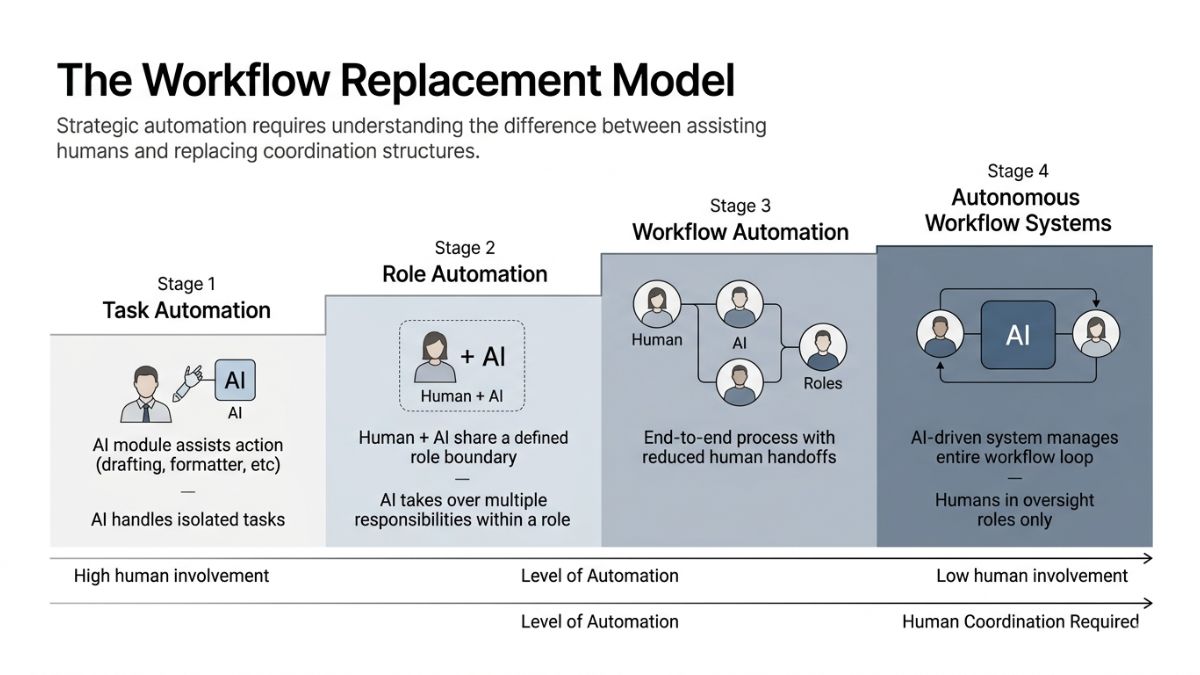
The Workflow Replacement Model is a four-stage diagnostic framework for classifying AI agent deployments by their scope of impact — from task-level assistance to fully autonomous multi-agent systems.
It identifies which workflows deliver structural capability gains, not just efficiency improvements, when automated, using coordination cost density as the primary selection criterion.
The four stages
- Stage 1 — Task Automation: Agents assist with individual activities within a human-controlled workflow. A lawyer using AI to draft contract clauses still owns the workflow: research, drafting, review, negotiation, approval. The agent accelerates one task; coordination remains manual.
- Stage 2 — Role Automation: Agents handle complete sub-functions but remain embedded in human-coordinated workflows. An AI that generates entire contract drafts still requires human review, negotiation strategy, and client communication.
- Stage 3 — Workflow Automation: Agents execute multi-step processes across traditional role boundaries with minimal human intervention. An AI that generates contracts, routes them for approval based on risk thresholds, tracks negotiation status, and escalates exceptions eliminates the coordination layer between legal, procurement, and business units.
- Stage 4 — Autonomous Workflow Systems: Multiple agent systems coordinate across organizational functions with human oversight at strategic decision points only.
Most organizations currently operate between Stage 1 and Stage 2, deploying copilots that assist rather than replace workflows.
The strategic error is treating these as automatic stepping stones to Stage 3 when they're actually different architectural decisions with different governance requirements.
Four diagnostic questions
Workflows worth automating are defined by coordination cost density, not task complexity. Four diagnostic questions:
- How many handoffs does this workflow require between departments or roles?
- What percentage of workflow time is coordination overhead versus actual value creation?
- Does workflow latency create organizational constraints — decisions deferred, opportunities missed, capabilities foregone?
- Could this workflow run continuously if coordination costs were zero?
Consider a multi-department onboarding workflow touching HR, IT, facilities, legal, and department management — where coordination overhead consumes 60% of elapsed time, creating hiring delays and capability constraints.
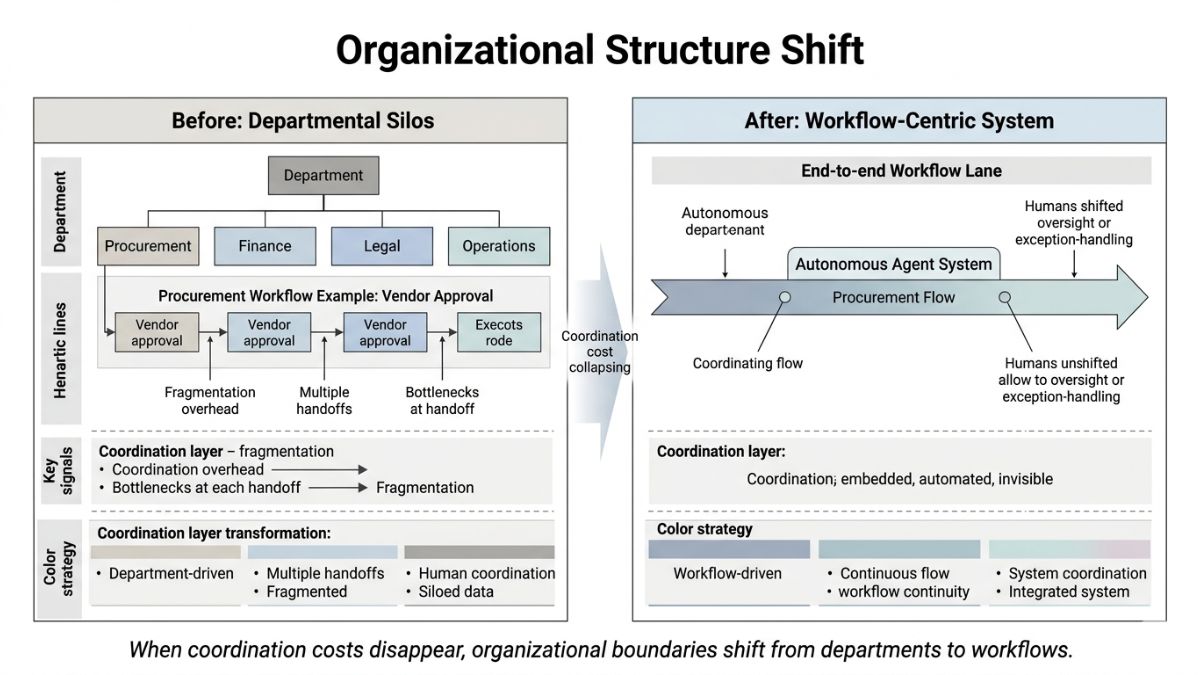
With an autonomous onboarding system coordinating provisioning, documentation, training, and compliance across departments, coordination cost approaches zero. The organization can onboard at volumes previously impossible — not faster, but at a scale that simply wasn't viable before.
Efficiency automation makes existing workflows faster. Workflow automation makes previously impossible workflows viable.
The Workflow Replacement Model identifies where to deploy. AgentOps defines how to do it without operational chaos.
AgentOps: Closing the Prototype-to-Production Gap for Multi-Agent Systems
Most enterprise agent initiatives fail to exit the test environment. The constraint isn't model capability — it's the absence of operational infrastructure for managing autonomous systems at scale.
Benjamin D., a CIO with enterprise AI deployments across healthcare organizations, frames the shift precisely:
"In enterprise settings, the differentiator is increasingly operational: what systems will let AI do safely, repeatedly, and with proof."
The bottleneck has moved from whether the model can perform the task to whether the organization can govern the model performing it in production.
McKinsey's 2025 data confirms the pattern: while 79% of organizations report using generative AI, fewer than 10% have deployed agentic AI at functional scale in any single function. Adoption is broad. Production is rare.
The prototype-to-production gap is structural, not technical. Organizations need ROI data to justify the infrastructure investment required for production-grade performance, but they can't generate ROI data without that infrastructure investment.
The result: pilots that demonstrate capability but never achieve production reliability.
One practitioner managing customer service agents solved this through calibrated restriction — agents operating at 90%+ query coverage at approximately $500 per month in API costs, replacing work equivalent to multiple human agents. The key wasn't maximum autonomy. It was bounded authority with explicit failure modes and escalation paths.
AgentOps emerges as the operational discipline that makes this governable. Three pillars define it.
Pillar 1: Tiered Authority Design
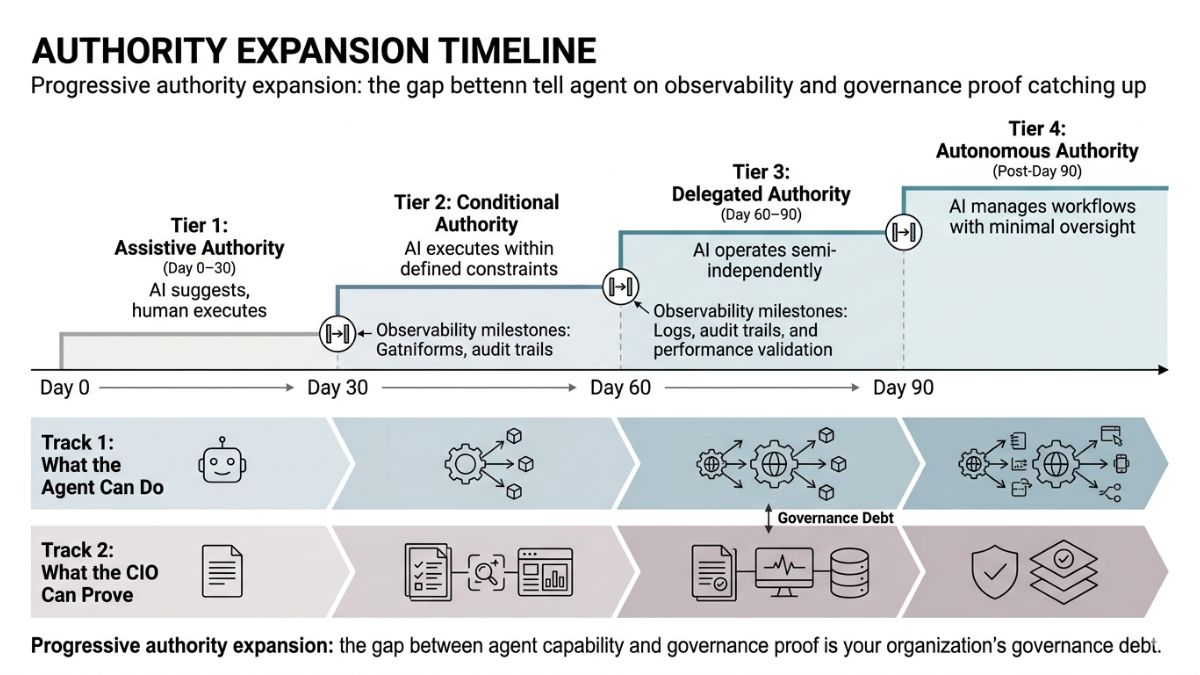
Tiered Authority Design — agents don't receive binary approval or restriction. They advance through authority levels triggered by observability data:
- Read-only: agents observe and report, taking no action — a procurement agent analyzes spend patterns and surfaces optimization opportunities
- Recommend: agents propose actions and humans approve
- Execute with approval: agents act within bounded scope and escalate exceptions — the procurement agent generates purchase orders under $50,000 within pre-approved vendor lists; everything outside those parameters requires human sign-off
- Execute autonomously: agents act within defined risk thresholds and escalate only when observability systems detect anomalies — humans receive audit trails, not approval requests
Authority expansion isn't a confidence judgment. It's evidence-based: documented behavior over defined periods, observability data showing decision patterns within acceptable variance, compliance artifacts proving audit-ready governance.
Pillar 2: Observability Infrastructure
Observability Infrastructure — the capability most organizations lack and most governance frameworks don't address. Without the ability to trace what agents actually did and why across multi-agent workflows, governance becomes theater.
Requirements include tool-call logging capturing every agent action and decision input, decision trace reconstruction, failure mode documentation, and audit artifact generation.
Alexander Granado, a governance and risk leader who has built AI control frameworks for regulated industries, describes what audit-ready observability actually requires:
"That means explicit control taxonomy mapping, clear risk coverage, meaningful KRIs for monitoring risk fluctuation, and human-friendly artifacts tied to assurance models."
This isn't a monitoring dashboard. It's governance infrastructure that makes autonomous systems auditable — documented, testable, and explainable to regulators.
Pillar 3: Compliance-Ready Governance Artifacts
Compliance-Ready Governance Artifacts — documentation satisfying regulatory requirements without creating approval bottlenecks: authority boundary specifications, escalation protocols, decision audit trails, and variance monitoring showing when agent behavior deviates from expected patterns.
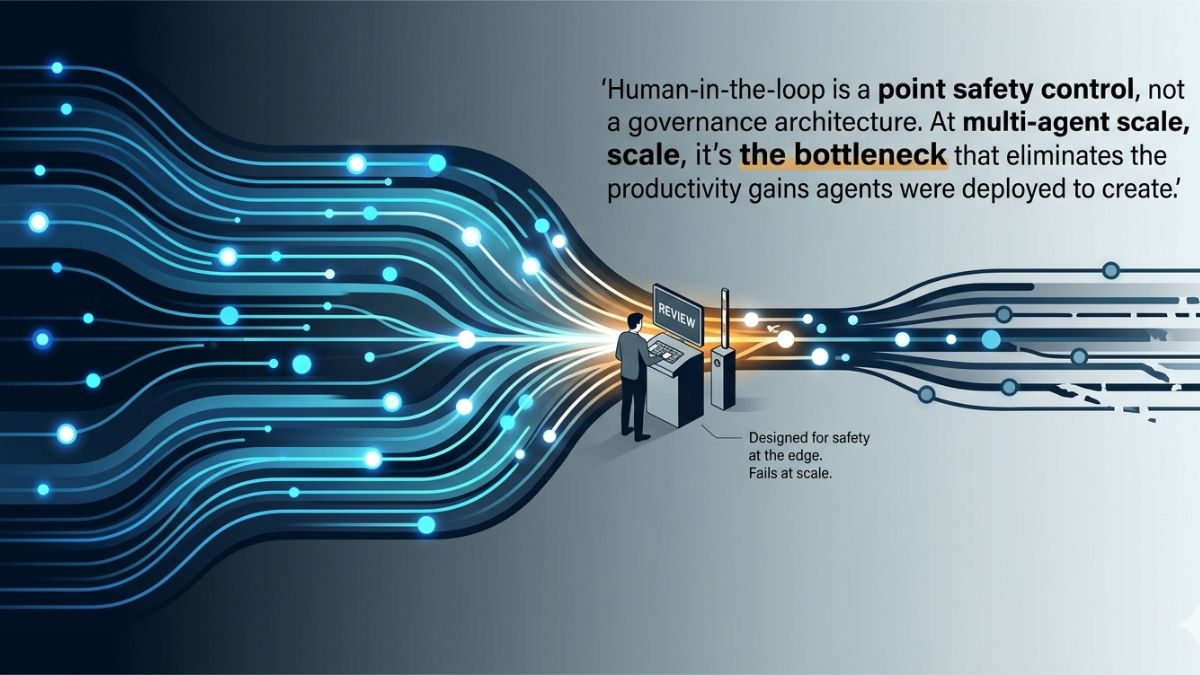
Human-in-the-loop is a starting constraint, not a governance architecture.
At single-agent scale, requiring human approval for every action is cautious. At multi-agent scale producing thousands of decisions daily, it becomes the bottleneck that eliminates the productivity gains agents were deployed to create.
The production model isn't binary human-in-the-loop. It's calibrated authority with observability-triggered escalation.
The Pilot of the Autopilot: Sovereign Control Over Autonomous AI Agents
The governance aspiration isn't micromanagement. It's sovereign oversight — the architecture that lets CIOs delegate with confidence and retrieve authority instantly.
One enterprise architect who has designed multi-agent systems describes the target state:
"As a human I want to be the pilot of a highly secure autopilot aircraft, not the human in a dystopian, Chaplinesque factory loop."
Aircraft autopilots operate autonomously within defined parameters. Pilots maintain authority at every moment. The system provides constant observability. Anomalies trigger alerts, not shutdowns.
The Pilot of the Autopilot architecture has three components.
Component 1: Progressive Authority Expansion
Progressive Authority Expansion — deployment readiness isn't granted at launch; it's earned through observability data. The model:
Authority Level × Observability Capability × Compliance Documentation = Deployment Readiness Score
An agent can't advance from "recommend" to "execute with approval" until it has demonstrated consistent decision patterns across sufficient scenarios, observability infrastructure can trace every decision path, and compliance artifacts document governance boundaries.
This addresses the confidence problem plaguing most deployments. Organizations tend to either over-restrict agents to uselessness or under-restrict them to regulatory exposure.
Progressive authority starts with maximum restriction and expands only when evidence justifies it.
Component 2: Real-Time Governance Visibility
Real-Time Governance Visibility — the capability to know what every agent is doing, trace why it made each decision, and intervene when necessary.
Without this infrastructure, CIOs are governing systems they can't observe. That isn't governance. That's hope.
Component 3: The Agent Readiness Audit
The Agent Readiness Audit — five diagnostic questions for any deployment:
- Do you have documented authority boundaries specifying exactly what this agent can and cannot do?
- Do you have observability tooling that captures tool-call traces and decision logic for audit reconstruction?
- Do you have formal escalation paths defining when and how agent decisions route to human oversight?
- Do you have compliance artifacts proving this deployment meets regulatory requirements in your industry?
- Do you have vocabulary alignment across legal, IT, compliance, and business teams on what "agent," "autonomous," and "delegated authority" actually mean?
Near-universal gaps in all five identify organizations that have deployed agents without AgentOps discipline.
The vocabulary gap alone — question five — is operationally consequential: when "AI agent" means different things in the same governance meeting, decisions are made without shared understanding of what is being governed. That's where regulatory exposure begins, before a single autonomous action is executed.
The organizations building this architecture now are defining competitive structure. Those treating agents as productivity overlays may find their organizational design has become a structural disadvantage — not because they chose the wrong models, but because they never built the operational infrastructure to govern the models they chose.
Conclusion: AI Organizational Restructuring Starts With the Right Frame
Return to Klarna. The organizations that framed it as a jobs story are preparing reskilling programs and monitoring headcount. The organizations that framed it as a coordination cost story are building AgentOps infrastructure and auditing which workflows to automate next.
Klarna itself, having moved to a hybrid human-AI model by 2025, learned what both frames cost when neither is complete — and that lesson is available to every CIO who plans before deploying rather than after.
The difference isn't philosophical. It's strategic. Job replacement thinking produces workforce planning. Coordination cost thinking produces organizational restructuring.
One optimizes existing operations. The other unlocks capabilities that were previously impossible.
CIOs face a concrete choice in 2026: deploy agents as efficiency tools within existing workflows, or restructure workflows around agent capabilities.
The first path delivers incremental productivity gains. The second may deliver competitive advantage through operations that competitors can't match without similar restructuring — the defining asymmetry of the enterprise AI agent landscape in 2026.
The Workflow Replacement Model provides the audit framework. AgentOps provides the operational discipline. The Pilot of the Autopilot provides the governance architecture.
Together, they give technology leaders the instruments to answer when boards ask: what does this organization look like when agents run our workflows?
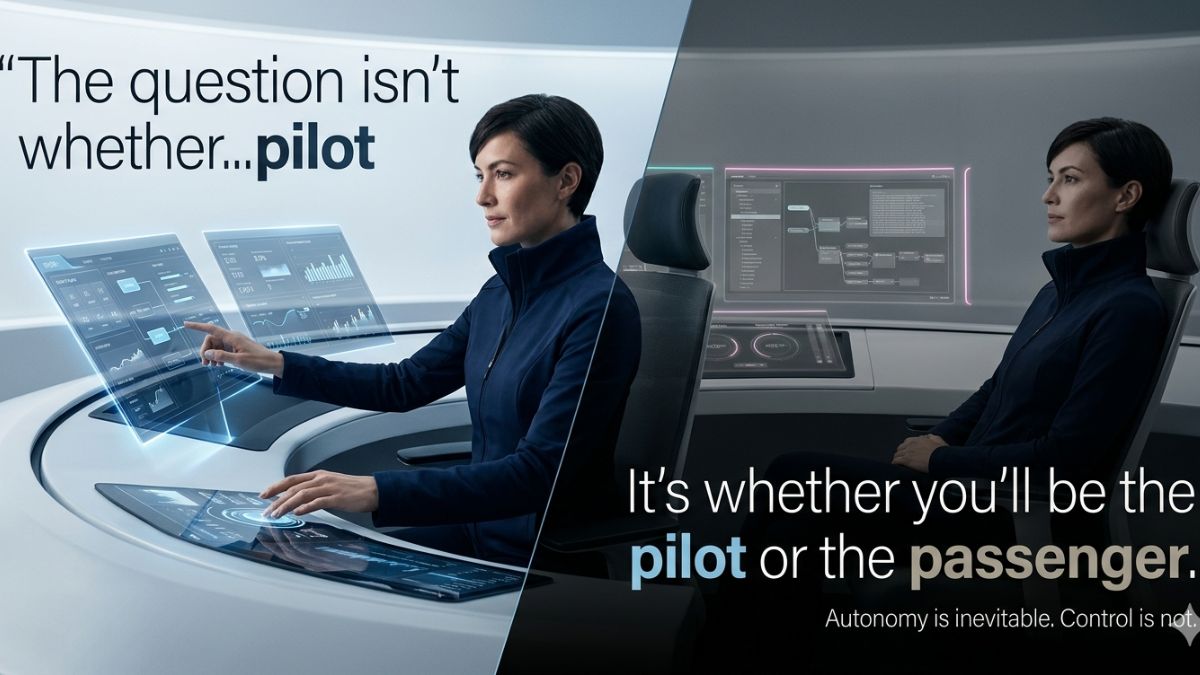
The question isn't whether your organization will run autonomous workflows. It's whether you'll be the pilot or the passenger.
Frequently Asked Questions
What is the AI agent economy and why does it matter for enterprise leaders?
The AI agent economy refers to the emerging commercial and organizational ecosystem where autonomous AI agents execute workflows, eliminate coordination costs, and unlock capabilities previously impossible at scale. It matters because it restructures the economic boundaries of the firm — not just the efficiency of individual tasks.
How is workflow automation with AI agents different from task automation?
Task automation speeds up individual activities within existing coordination structures. Workflow automation — driven by multi-agent systems — eliminates the coordination structure entirely, converting a 17-step approval chain into a continuously running autonomous process. The output isn't a faster process; it's a new organizational capability.
What is AgentOps and what problems does it solve?
AgentOps is the operational discipline governing autonomous AI agent deployment at enterprise scale. It solves the prototype-to-production gap by providing tiered authority design, observability infrastructure, and compliance-ready governance artifacts — enabling organizations to move agents from pilots into production without creating regulatory exposure or operational chaos.
Why do single-agent deployments fail to generate meaningful ROI?
Enterprise workflows are inherently multi-step and cross-departmental. A single agent automating one step produces marginal efficiency. Enterprise practitioners consistently find that approximately 20 coordinated agents are required to transform a job function — because only at that threshold does coordination cost actually approach zero.
How should a CIO govern autonomous AI agents without micromanaging them?
Through the Pilot of the Autopilot model: progressive authority expansion grounded in observability data, real-time governance visibility across all agent actions, and a pre-deployment Agent Readiness Audit covering authority boundaries, escalation paths, and compliance documentation. Sovereign control means authority remains human; execution becomes autonomous.